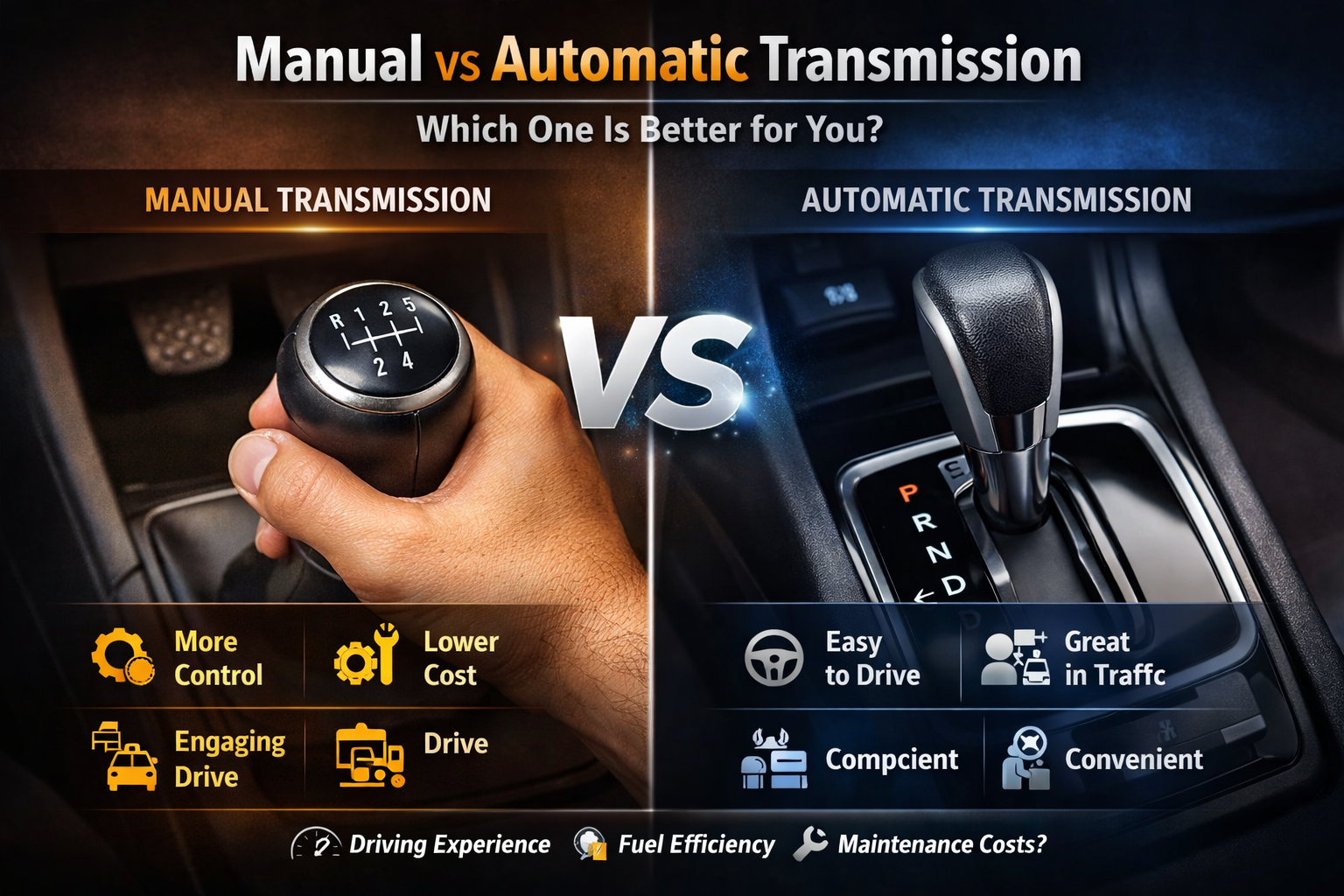
Choosing the right transmission type is one of the most important decisions when buying a car. Many drivers often compare manual vs automatic transmission to understand which option suits their driving needs, lifestyle, and budget.
Both transmission systems are designed to transfer power from the engine to the wheels, but they function in very different ways. Each comes with its own advantages and limitations. Understanding the difference between manual and automatic transmission can help you make a smarter and more practical choice.
In this guide, we’ll explore how both systems work, compare their features, and help you decide which transmission is better—manual or automatic.
What Is a Manual Transmission?
A manual transmission requires the driver to change gears using a clutch pedal and gear lever. The driver controls when to shift gears based on speed and driving conditions.
Manual cars offer a more hands-on driving experience. Many drivers prefer them because they provide better control over the vehicle and engine performance.
What Is an Automatic Transmission?
An automatic transmission changes gears on its own without requiring driver input. It uses sensors, hydraulic systems, and electronic controls to determine the correct gear at the right time.
Automatic cars are designed for convenience, making them easier to drive, especially in city traffic or for beginner drivers.
Difference Between Manual and Automatic Transmission
To better understand manual transmission vs automatic transmission cars, let’s compare them across key factors:
1. Driving Experience
- Manual Transmission: Offers full control over gear shifting and engine performance.
- Automatic Transmission: Focuses on ease and comfort by handling gear changes automatically.
Manual cars are ideal for drivers who enjoy active driving, while automatic cars are better for relaxed driving.
2. Ease of Use
- Manual: Requires coordination between clutch and gear shifting.
- Automatic: Simple to drive with no clutch involvement.
For beginners or city drivers, automatic transmission is much easier to manage.
3. Traffic Conditions
- Manual: Can be tiring in heavy traffic due to constant gear changes.
- Automatic: Perfect for stop-and-go traffic situations.
If you drive daily in crowded areas, automatic cars provide a smoother experience.
4. Fuel Efficiency
In the past, manual cars were more fuel-efficient. However, modern automatic transmissions have significantly improved.
- Manual: Slight advantage in older models
- Automatic: Comparable or sometimes better in newer vehicles
Today, the fuel efficiency difference between the two is minimal.
5. Maintenance and Repair
- Manual Transmission: Simpler design, lower repair costs
- Automatic Transmission: More complex, higher maintenance costs
Automatic systems include advanced electronics and components, which can increase repair expenses.
Understanding automatic transmission repair problems can help you choose the right transmission type for long-term reliability.
6. Driving Comfort
- Manual: Requires more effort, especially during long drives
- Automatic: Provides a smooth and stress-free driving experience
Automatic transmission is preferred for comfort and convenience.
Which Transmission Is Better: Manual or Automatic?
There is no one-size-fits-all answer. The right choice depends on your driving habits and preferences.
Choose Manual Transmission If:
- You enjoy full control over your vehicle
- You drive mostly on highways
- You want lower maintenance costs
- You prefer a more engaging driving experience
Choose Automatic Transmission If:
- You drive frequently in city traffic
- You want a comfortable and easy driving experience
- You are a beginner driver
- You prefer convenience over manual control
If you’re still wondering which transmission is better manual or automatic, think about your daily driving conditions and comfort level.
Manual Transmission vs Automatic Transmission Cars: Pros and Cons
Manual Transmission – Advantages
- Greater control over gear shifting
- Lower maintenance and repair costs
- Generally more affordable
- Better driving engagement
Manual Transmission – Disadvantages
- Difficult for beginners
- Less convenient in heavy traffic
- Requires constant attention
Automatic Transmission – Advantages
- Easy to drive
- Ideal for urban traffic
- Smooth gear transitions
- Reduced driver fatigue
Automatic Transmission – Disadvantages
- Higher repair and maintenance costs
- Slightly more expensive upfront
- Less control over gear shifting
Modern Trends in Transmission Technology
The automotive industry is evolving rapidly, and automatic transmissions are becoming more advanced. Technologies like CVT (Continuously Variable Transmission) and dual-clutch systems are improving both efficiency and performance.
Many modern vehicles now come equipped with automatic transmission as standard, especially in cities where convenience is a priority. However, manual transmissions still remain popular among driving enthusiasts.
Final Thoughts
The comparison of manual vs automatic transmission ultimately comes down to personal preference and driving conditions.
If you value control, affordability, and a hands-on driving experience, manual transmission may be the right choice. On the other hand, if you prioritize comfort, ease of use, and convenience, automatic transmission is the better option.
Understanding the difference between manual and automatic transmission will help you choose a vehicle that matches your lifestyle and driving needs.
If you experience gearbox issues, visiting a professional automatic transmission repair center can help diagnose the problem early and prevent costly damage.
No matter which option you choose, regular maintenance and proper driving habits are essential for ensuring long-term vehicle performance.
Recent Posts
-
7 Signs Your Automatic Gearbox Needs Immediate Repair
April 10, 2026 -

Mercedes Automatic Service Center: What Services Are Included?
March 16, 2026 -

How to Choose the Best Gearbox Repair Specialist
March 16, 2026 -

Why You Should Choose an Automatic Transmission Specialist
March 13, 2026 -
Automatic Transmission Repair: Common Problems & Expert Solutions
March 12, 2026
Copyright © All Rights Reserved by SEHMBI