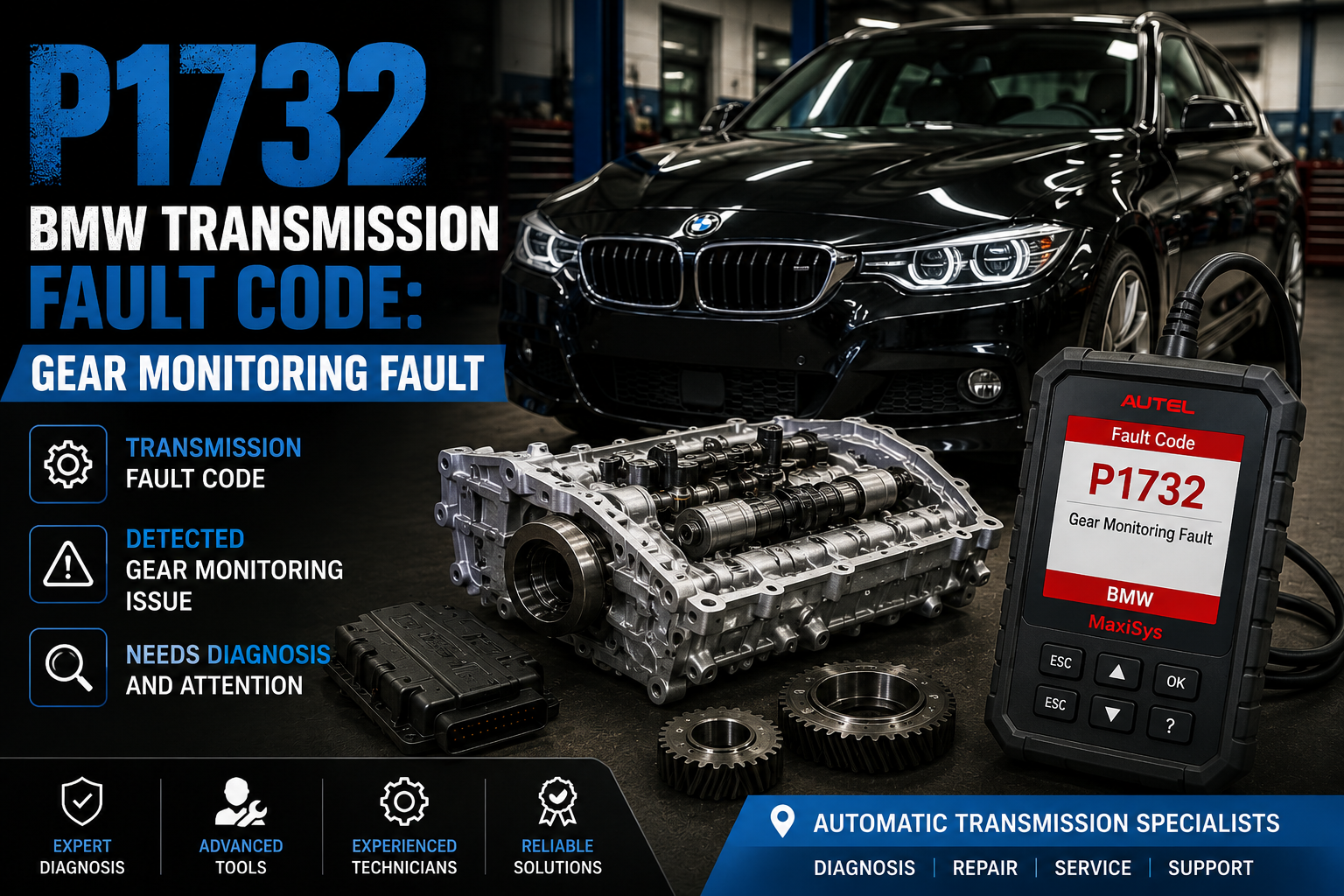
The P1732 BMW transmission fault code is a manufacturer-specific transmission code associated with 4th-gear monitoring. BMW identifies P1732 as “Gear Monitoring 4 at Electrical Substitute Program.” In simple terms, the BMW transmission control module, also known as the EGS, has detected that the actual behaviour of 4th gear does not match the expected operating condition.
When the BMW P1732 fault code appears, the vehicle may show transmission jerking, slipping, delayed engagement, a gearbox warning message, poor shifting, or BMW transmission limp mode. However, this code does not automatically mean the complete BMW gearbox has failed. The actual cause may be related to transmission fluid, speed sensors, solenoids, valve-body operation, hydraulic pressure, mechatronic control, adaptation values, wiring, or internal clutch wear.
Quick Answer: P1732 means the BMW EGS has detected an abnormal 4th-gear monitoring condition while the transmission is operating in a substitute or fail-safe strategy. Diagnosis should focus on transmission-fluid condition, input/output speed signals, valve-body operation, solenoids, hydraulic pressure, adaptation values, and internal clutch condition before considering gearbox replacement.
What Does P1732 Mean on BMW?
The P1732 BMW fault code is not a generic code that has the same definition for every vehicle brand. BMW uses this code specifically for a 4th-gear monitoring problem.
The EGS continuously compares the gear it commands with the actual response of the transmission. It uses several pieces of information, including input-shaft speed, output-shaft speed, selected gear, hydraulic pressure, solenoid operation, and clutch engagement.
If the gearbox is commanded into 4th gear but the actual speed relationship does not match what the control unit expects, the system may store a P1732 gear monitoring fault.
This may happen because the transmission is genuinely slipping, or because incorrect sensor or hydraulic information makes the EGS believe that the gear ratio is wrong.
If your BMW already has slipping, delayed engagement, or harsh shifts, read the signs your automatic gearbox needs immediate repair.
Common P1732 BMW Transmission Fault Symptoms
The exact symptoms of a P1732 BMW transmission fault depend on the gearbox type and root cause.
Common symptoms may include:
- BMW gearbox warning light
- BMW transmission malfunction message
- Check Engine Light
- BMW transmission jerking
- BMW gearbox jerking
- Delayed gear engagement
- BMW transmission slipping
- BMW gearbox slipping
- BMW not shifting properly
- BMW stuck in gear
- Reduced acceleration
- Restricted 4th-gear operation
- BMW gearbox limp mode
- BMW transmission limp mode
- P1732 returning after clearing
Some vehicles may shift normally when cold and begin to show problems after the transmission reaches operating temperature. This can happen when internal hydraulic leakage or clutch wear becomes more noticeable as the fluid heats up.
P1732 BMW Diagnostic Checklist
| Check |
Why It Matters |
| BMW-specific EGS scan |
Confirms P1732 and related transmission faults |
| Transmission fluid level |
Low fluid can reduce hydraulic pressure |
| Fluid condition |
Burnt fluid may indicate overheating or wear |
| Input speed sensor |
Helps calculate internal transmission ratio |
| Output speed sensor |
Confirms actual gearbox output speed |
| Shift solenoids |
Control hydraulic gear selection |
| Valve body |
Regulates pressure and clutch engagement |
| Adaptation values |
Shows how the transmission compensates for wear |
| Wiring/connectors |
Rules out signal and electrical faults |
| Internal clutch slip |
Confirms real mechanical ratio loss |
Important: P1732 does not automatically mean the complete BMW transmission has failed. Speed-sensor data, fluid condition, hydraulic pressure, valve-body operation, solenoids, adaptation values, and clutch slip should be checked before recommending a rebuild or replacement.
What Causes P1732 BMW Gear Monitoring Fault?
1. Low or Degraded Transmission Fluid
A BMW transmission fluid problem is one of the first areas that should be checked.
Automatic transmissions rely on the correct fluid level and condition to create the hydraulic pressure required for clutch and gear operation. A BMW low transmission fluid condition may cause slipping, delayed engagement, overheating, harsh shifts, or an incorrect gear ratio.
If 4th gear cannot hold correctly because hydraulic pressure is too low, the EGS may detect a mismatch and store P1732.
Low fluid should not simply be topped up. The workshop should check for leaks and follow the correct fill-temperature procedure for the specific BMW gearbox.
For more information, read How Often Should You Change Automatic Transmission Oil?.
2. BMW Transmission Speed Sensor Fault
A BMW transmission speed sensor fault can create incorrect gear-monitoring information.
The transmission controller compares input and output shaft speeds to determine whether the gearbox is operating in the commanded gear.
A BMW input speed sensor fault or BMW output speed sensor fault may cause:
- Incorrect gear-ratio calculation
- Erratic shifting
- BMW gearbox warning light
- Limp mode
- P1732 transmission error BMW
Technicians should compare live sensor data while the fault is present before replacing any speed sensor.
3. BMW Valve Body Problem
A BMW valve body problem can affect the hydraulic pressure needed to engage a specific gear.
The valve body directs transmission fluid through internal hydraulic passages. If valves become worn or stick, the required clutch circuit may not receive correct pressure.
Possible valve-body symptoms include:
- BMW gearbox slipping
- Delayed shifting
- Harsh engagement
- Gear hunting
- Incorrect gear ratio
- Gear monitoring faults
If the hydraulic circuit responsible for 4th gear does not operate correctly, the actual transmission ratio may differ from the commanded ratio.
4. BMW Transmission Solenoid Fault
A BMW transmission solenoid fault can also contribute to P1732.
Shift and pressure-control solenoids regulate fluid pressure inside the gearbox. If a solenoid does not respond correctly, the transmission may fail to engage the required clutch or gear.
Symptoms may include:
- Delayed gear changes
- Harsh shifts
- Transmission slipping
- Incorrect pressure
- Limp mode
- Gear monitoring errors
Solenoids should be tested electrically and functionally rather than replaced solely because P1732 is present.
5. BMW Mechatronic Fault
A BMW mechatronic fault is another possible diagnostic area, especially on transmissions that integrate electronic and hydraulic control into one assembly.
Possible mechatronic problems include:
- Pressure regulation failure
- Solenoid-control issues
- Internal electronics
- EGS communication faults
- Damaged connectors
- Adaptation problems
Because BMW mechatronic units can be expensive, a professional transmission diagnosis should confirm the problem with BMW-compatible scan tools and live data before repair or replacement.
6. Transmission Adaptation Problems
BMW automatic transmissions use learned adaptation values to compensate for clutch wear and changing hydraulic characteristics.
If adaptation values become excessive, incorrect, or are reset without repairing the original problem, the transmission may shift poorly.
Possible symptoms include:
- Harsh gear changes
- Delayed engagement
- Transmission slipping
- Gear monitoring errors
- P1732 returning after reset
Transmission adaptation should not be treated as a universal fix. The underlying mechanical or hydraulic problem should first be identified.
7. BMW Clutch Pack Wear or Internal Transmission Wear
BMW clutch pack wear can cause genuine internal gearbox slip.
When the clutch responsible for holding a particular gear cannot maintain sufficient torque, the input and output speeds no longer correspond to the expected ratio.
Possible causes of BMW internal transmission wear include:
- Worn clutch friction plates
- Damaged clutch components
- Internal seal leakage
- Worn bushings
- Mechanical gear damage
This type of problem may require internal gearbox repair or rebuilding. However, electronic, fluid, sensor, solenoid, and valve-body faults should be ruled out before an overhaul is recommended.
P1732 vs Related BMW Transmission Codes
Related codes can help technicians understand whether P1732 is part of a broader gearbox problem.
| Fault Code |
General BMW Description |
| P1731 |
Gear 1 manual incorrect ratio |
| P1732 |
Gear Monitoring 4 at Electrical Substitute Program |
| P1733 |
Internal transmission control module error |
| P1734 |
Pressure-control solenoid electrical fault |
| P1736 |
Gear 6 incorrect ratio |
If P1732 appears together with speed-sensor, pressure-control, or gear-ratio codes, those additional faults can provide important clues.
This is why proper BMW transmission diagnosis should evaluate all EGS codes together rather than focusing on one code alone.
Can P1732 Cause BMW Transmission Limp Mode?
Yes.
A serious BMW gear monitoring fault can trigger a fail-safe or substitute operating mode.
Possible BMW transmission limp mode symptoms include:
- Gearbox stuck in one gear
- Limited gear selection
- Reduced acceleration
- Harsh engagement
- Transmission warning message
- Restricted shifting
Limp mode is designed to reduce further transmission stress when the EGS cannot reliably confirm normal operation.
If your vehicle repeatedly enters fail-safe mode, read Why Is My Car Stuck in Limp Mode? Causes & Fixes.
Can You Drive With P1732 BMW Fault Code?
Driving should be limited if the BMW is slipping, jerking heavily, overheating, becoming stuck in gear, or repeatedly entering limp mode.
A transmission that is genuinely slipping can generate excessive heat and accelerate clutch damage.
If the vehicle is only displaying a warning but still shifts normally, a short trip to a specialist may be possible. However, continued normal driving without diagnosis is not recommended.
How Is P1732 BMW Diagnosed?
A proper P1732 BMW diagnosis and repair process should include:
- Scan the EGS with BMW-compatible diagnostic equipment.
- Confirm P1732 and record all related fault codes.
- Check transmission-fluid level and condition.
- Monitor gearbox temperature.
- Compare input and output speed signals.
- Test shift and pressure-control solenoids.
- Review transmission adaptation values.
- Inspect wiring and electrical connectors.
- Evaluate valve-body operation.
- Check hydraulic pressure where required.
- Confirm actual clutch slip.
- Inspect internal components only after other causes have been eliminated.
This structured approach helps avoid unnecessary transmission replacement.
P1732 BMW Repair Options
The correct repair depends on diagnosis.
Transmission fluid correction: Suitable when fluid level or condition is causing hydraulic problems.
Speed-sensor or wiring repair: Required when incorrect sensor signals or damaged circuits are confirmed.
Solenoid repair: Appropriate when testing identifies a faulty shift or pressure-control solenoid.
Valve-body repair: Needed when hydraulic regulation is causing improper gear engagement.
Mechatronic repair: Required when electronic or hydraulic transmission control is faulty.
Transmission adaptation: May be carried out after the actual fault is repaired.
Internal gearbox repair: Necessary when clutch packs, seals, or mechanical components are worn.
Transmission rebuild or replacement: Should be recommended only when internal damage is confirmed and targeted repair is no longer practical.
For another BMW-specific transmission issue, read the BMW P17E1 transmission fault code repair guide.
P1732 BMW Transmission Repair Cost in Mumbai
The P1732 BMW transmission repair cost or P1732 BMW gearbox repair cost depends on the actual cause.
The repair may involve:
- Computerized diagnosis
- Transmission-fluid correction
- Wiring repair
- Sensor replacement
- Solenoid replacement
- Valve-body repair
- Mechatronic repair
- Clutch repair
- Complete gearbox overhaul
For broader pricing guidance, read our Automatic Transmission Repair Cost in Mumbai – 2026 Price Guide.
P1732 BMW Transmission Fault Repair in Mumbai
If you are looking for BMW transmission repair Mumbai, BMW gearbox repair Mumbai, or a BMW automatic gearbox specialist, accurate diagnosis should always come before expensive component replacement.
SEHMBI Automatic Transmission Repair Center provides computerized automatic-transmission diagnosis, gearbox repair, valve-body assessment, and mechatronic repair services.
Visit the SEHMBI Automatic Transmission Repair Center for specialist transmission diagnosis in Mumbai.
BMW Showing P1732, Gearbox Warning or Limp Mode?
Have the transmission fluid, speed sensors, solenoids, valve body, hydraulic pressure, mechatronic system, adaptation values, and clutch condition checked before approving a gearbox rebuild or replacement.
Call SEHMBI: +91 98337 71779
Frequently Asked Questions
What does P1732 mean on BMW?
P1732 is a BMW transmission code associated with 4th-gear monitoring in an electrical substitute program. It means the EGS has detected that actual transmission behaviour does not match the expected 4th-gear condition.
What causes P1732 BMW transmission fault code?
Possible causes include low or degraded fluid, speed-sensor problems, hydraulic-pressure faults, solenoid issues, valve-body wear, mechatronic faults, adaptation problems, or internal clutch wear.
Can low transmission fluid cause P1732 BMW?
Low fluid can contribute to hydraulic-pressure loss and clutch slip, so the level and condition should be checked during diagnosis.
Can a transmission solenoid cause P1732 BMW?
Yes. A faulty shift or pressure-control solenoid can prevent correct gear engagement and contribute to a gear-monitoring fault.
Does P1732 mean BMW gearbox failure?
No. Electrical, sensor, hydraulic, valve-body, and mechatronic faults can also cause P1732. Full gearbox failure should not be diagnosed from the code alone.
Can P1732 cause BMW transmission limp mode?
Yes. If the EGS cannot reliably verify correct gear operation, the transmission may enter a fail-safe or substitute mode.
Can P1732 be repaired without replacing the transmission?
Yes. Depending on the cause, fluid correction, wiring repair, sensor replacement, solenoid repair, valve-body work, or mechatronic repair may solve the issue without replacing the complete gearbox.
What is the P1732 BMW transmission repair cost?
The cost depends on whether the problem is electrical, hydraulic, or internal mechanical wear. A full scan and diagnosis are required before an accurate quotation can be given.