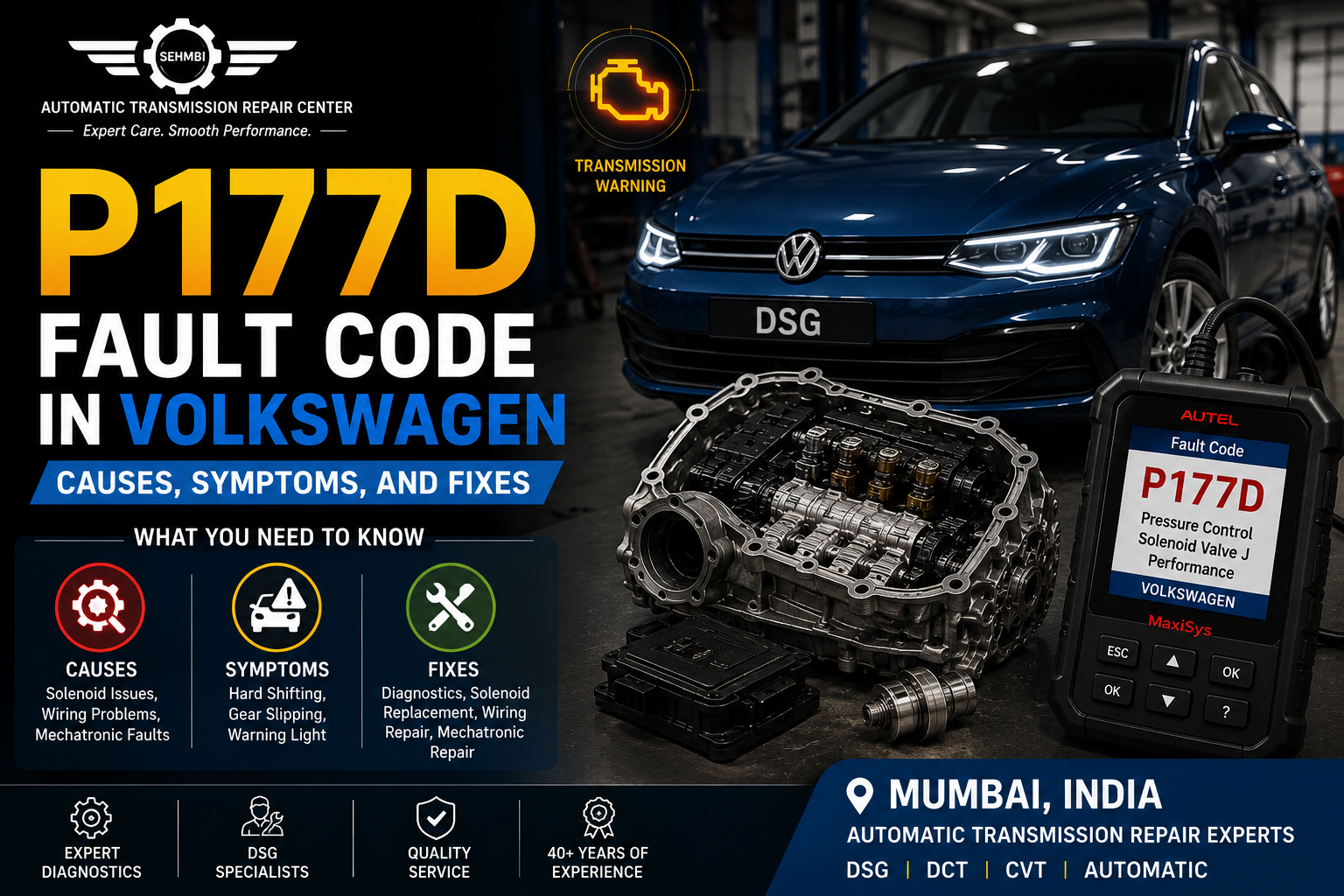
The P177D Volkswagen fault code is commonly associated with an abnormal dual-clutch torque too high condition on Volkswagen vehicles equipped with the 7-speed DSG/DQ200 (0AM/0CW) transmission. When this P177D DSG fault code appears, the gearbox may jerk, slam into gear, fail Basic Settings, enter limp mode or show abnormal clutch engagement.
A documented 0AM/DQ200 technical reference specifically describes P177D as “clutch torque too high,” often appearing after mechatronic replacement or adaptation work.
P177D Quick Answer: P177D generally means the DQ200 DSG is detecting excessive or abnormal clutch torque. Diagnosis should focus on clutch adaptation, clutch wear, mechatronic control, Basic Settings, electrical supply and related DSG fault codes before replacing the complete gearbox.
What Does P177D Volkswagen Fault Code Mean?
The Volkswagen P177D fault code usually relates to the dual-clutch system inside the 7-speed DSG.
The DQ200 transmission uses two clutches to control alternating gear sets. Correct clutch engagement depends on learned adaptation values, mechanical clutch condition and accurate mechatronic control.
Ross-Tech’s official DQ200 Basic Settings procedure shows that the transmission must complete a defined calibration process before normal clutch operation is confirmed. The procedure also states that if the expected Basic Settings result is not achieved, the engine should not be started because something is wrong with the procedure or transmission.
A P177D transmission fault may therefore involve:
- DSG clutch adaptation
- Dual-clutch wear
- Mechatronic control
- Hydraulic clutch operation
- Transmission coding
- Failed Basic Settings
- Incorrect installation after repair
For more DSG background, read our Volkswagen DSG transmission repair guide.
Common P177D Fault Code Symptoms
The exact P177D fault code symptoms depend on whether the problem comes from clutch wear, adaptation or mechatronic control.
Common symptoms include:
- Volkswagen DSG jerking
- Gearbox slamming into Drive or Reverse
- DSG slipping
- Hard gear engagement
- Delayed Drive or Reverse
- Volkswagen DSG not shifting properly
- Volkswagen transmission warning light
- DSG gearbox warning light
- Volkswagen gearbox stuck in gear
- Volkswagen DSG limp mode
- Failed Basic Settings
- P177D returning after clearing
- Engine RPM dropping heavily during engagement
- Engine stalling when a clutch engages
Published DQ200 P177D cases describe symptoms such as the gearbox banging into gear, stalling the engine and Basic Settings failing.
If your gearbox is already jerking or slipping, review the signs your automatic gearbox needs immediate repair.
P177D Diagnostic Checklist
| Check |
Why It Matters |
| Clutch adaptation values |
Shows whether learned clutch positions are plausible |
| Basic Settings status |
Identifies calibration failure |
| Clutch slip data |
Helps detect worn clutch components |
| Mechatronic coding |
Important after replacement or repair |
| Battery voltage |
Low voltage can disrupt DSG procedures |
| Related DTCs |
May reveal pressure, clutch or sensor faults |
| Mechanical installation |
Incorrect installation can prevent adaptation |
Important: P177D does not automatically mean the complete DSG gearbox or mechatronic unit has failed. Clutch condition, calibration, mechatronic control and installation should all be checked first.
What Causes P177D in Volkswagen DSG?
1. Incorrect DSG clutch adaptation
One of the most important causes to investigate is DSG clutch adaptation.
After clutch replacement, mechatronic work or certain DSG repairs, the transmission may need Basic Settings and a defined adaptation drive.
Ross-Tech specifies strict prerequisites for DQ200 Basic Settings and confirms that the gearbox adapts clutch tolerances during the procedure.
If the transmission cannot correctly learn clutch position or torque, you may see:
- P177D clutch fault
- Harsh engagement
- DSG judder
- Clutch grabbing
- Failed adaptation
This is why generic “reset DSG” procedures should not replace the correct Volkswagen-specific calibration process.
2. Worn DSG clutch pack
A P177D clutch fault may also indicate mechanical clutch wear.
As a DSG clutch wears, the control module has to compensate through adaptation. Eventually, the clutch may move outside the expected operating range.
Possible symptoms include:
- DSG slipping
- Jerking during take-off
- Delayed engagement
- Poor acceleration
- Harsh clutch application
When testing confirms excessive wear, clutch-pack replacement may be necessary.
However, P177D alone should not be treated as proof that the clutch pack has failed.
3. DSG mechatronic problem
A P177D DSG mechatronic fault is another possible cause.
The mechatronic unit controls:
- Clutch actuation
- Hydraulic pressure
- Gear selection
- Solenoid operation
- Transmission adaptation
A control or hydraulic problem may make a healthy clutch engage incorrectly.
Ross-Tech also notes that incorrect mechatronic installation is responsible for many DQ200 support requests and recommends following the proper replacement procedure carefully.
If your Volkswagen also has pressure-related faults, read our P189C Volkswagen DSG fault code guide.
4. Incorrect installation after mechatronic or clutch repair
P177D may appear after previous DSG work.
A technical P177D document describes the code appearing after mechatronic replacement and adaptation on a 0AM transmission.
After repair, technicians should verify:
- Correct mechatronic installation
- Correct clutch installation
- Transmission coding
- Basic Settings completion
- Adaptation values
- Battery voltage
- Related fault codes
A new part will not work correctly if the installation or calibration is wrong.
5. Electrical or voltage problems
DSG calibration depends on stable electrical supply.
Low battery voltage, poor grounds, wiring issues or intermittent electrical supply may interfere with adaptation or mechatronic operation.
This should be checked before expensive clutch or mechatronic replacement is approved.
Is P177D a Mechatronic or Clutch Fault?
It can be either.
A professional P177D transmission diagnosis Volkswagen should distinguish between a mechanically worn clutch and an incorrectly controlled clutch.
A sensible diagnostic sequence is:
- Confirm P177D with Volkswagen-compatible diagnostics.
- Scan for related DSG codes.
- Check clutch adaptation values.
- Check clutch slip data.
- Verify mechatronic coding.
- Confirm Basic Settings status.
- Inspect power supply and battery voltage.
- Evaluate hydraulic/mechatronic operation.
- Assess clutch wear.
- Perform adaptation after the actual fault is repaired.
For specialist diagnosis, visit our Volkswagen automatic transmission repair service. SEHMBI lists Volkswagen transmission repair coverage across Mumbai areas including Malad, Borivali, Goregaon, Bandra, Andheri, Thane and Navi Mumbai.
Can P177D Cause Volkswagen DSG Limp Mode?
Yes. A serious clutch-control problem can trigger Volkswagen DSG limp mode.
Possible limp-mode symptoms include:
- Gearbox stuck in one gear
- Limited gear availability
- Failure to select Drive or Reverse
- Flashing DSG indicator
- Harsh engagement
- Reduced acceleration
Limp mode is a protective response, not the actual repair.
If the vehicle repeatedly enters protection mode, read Why Is My Car Stuck in Limp Mode? Causes & Fixes.
Can You Drive With P177D?
Continued driving is not recommended if the gearbox is:
- Slamming into gear
- Slipping heavily
- Stalling the engine
- Losing Drive or Reverse
- Repeatedly entering limp mode
Harsh engagement can increase clutch and internal DSG stress.
Get the gearbox diagnosed before normal use.
P177D Volkswagen Repair Options
The correct P177D fault code fix depends on the confirmed cause.
Basic Settings and adaptation: Suitable where components are healthy but calibration is incomplete or incorrect.
Electrical repair: Needed if poor voltage, wiring or power supply interferes with DSG operation.
Mechatronic repair: Required when hydraulic or electronic clutch control is faulty.
Clutch-pack replacement: Appropriate when testing confirms excessive mechanical clutch wear.
Internal gearbox repair: Required only if additional mechanical damage is found.
A complete gearbox replacement should generally be considered only after targeted repair options have been ruled out.
P177D Volkswagen DSG Repair Cost in Mumbai
The P177D Volkswagen DSG repair cost can vary significantly because the code can involve adaptation, clutch or mechatronic work.
Possible costs may include:
- Computerized DSG diagnosis
- Basic Settings/adaptation
- Wiring or electrical repair
- Mechatronic repair
- Hydraulic repair
- Clutch-pack replacement
- Internal DSG rebuilding
For broader cost guidance, read our Automatic Transmission Repair Cost in Mumbai – 2026 Price Guide.
P177D Volkswagen Gearbox Repair in Mumbai
If you need P177D Volkswagen gearbox repair in Mumbai, diagnose the transmission before approving clutch, mechatronic or complete DSG replacement.
SEHMBI’s existing P177D resource also describes the code as a clutch-torque-too-high condition on DQ200/0AM DSG applications and highlights hard shifting, slamming into gear and stalling as possible symptoms.
Volkswagen Showing P177D, DSG Jerking or Limp Mode?
Book a complete DSG clutch, adaptation and mechatronic diagnosis before replacing major components.
Call SEHMBI: +91 98337 71779
Frequently Asked Questions
What does P177D mean on Volkswagen?
P177D is commonly documented on DQ200/0AM DSG transmissions as dual-clutch torque too high.
What causes P177D Volkswagen fault code?
Common diagnostic areas include incorrect clutch adaptation, clutch wear, mechatronic control issues, failed Basic Settings and installation problems.
Is P177D a mechatronic fault?
It can be. A mechatronic control problem can cause abnormal clutch engagement, but clutch wear may create similar symptoms.
Does P177D mean clutch failure?
No. P177D should lead to clutch and mechatronic diagnosis, not automatic clutch replacement.
Can P177D cause DSG limp mode?
Yes. If clutch operation becomes unreliable, the transmission may restrict gear operation.
Can P177D be repaired without replacing the gearbox?
Yes. Depending on diagnosis, adaptation, electrical repair, mechatronic repair or clutch replacement may solve the fault without complete gearbox replacement.
What should be done after P177D repair?
When applicable, the correct DQ200 Basic Settings and adaptation drive should be completed using the proper procedure.