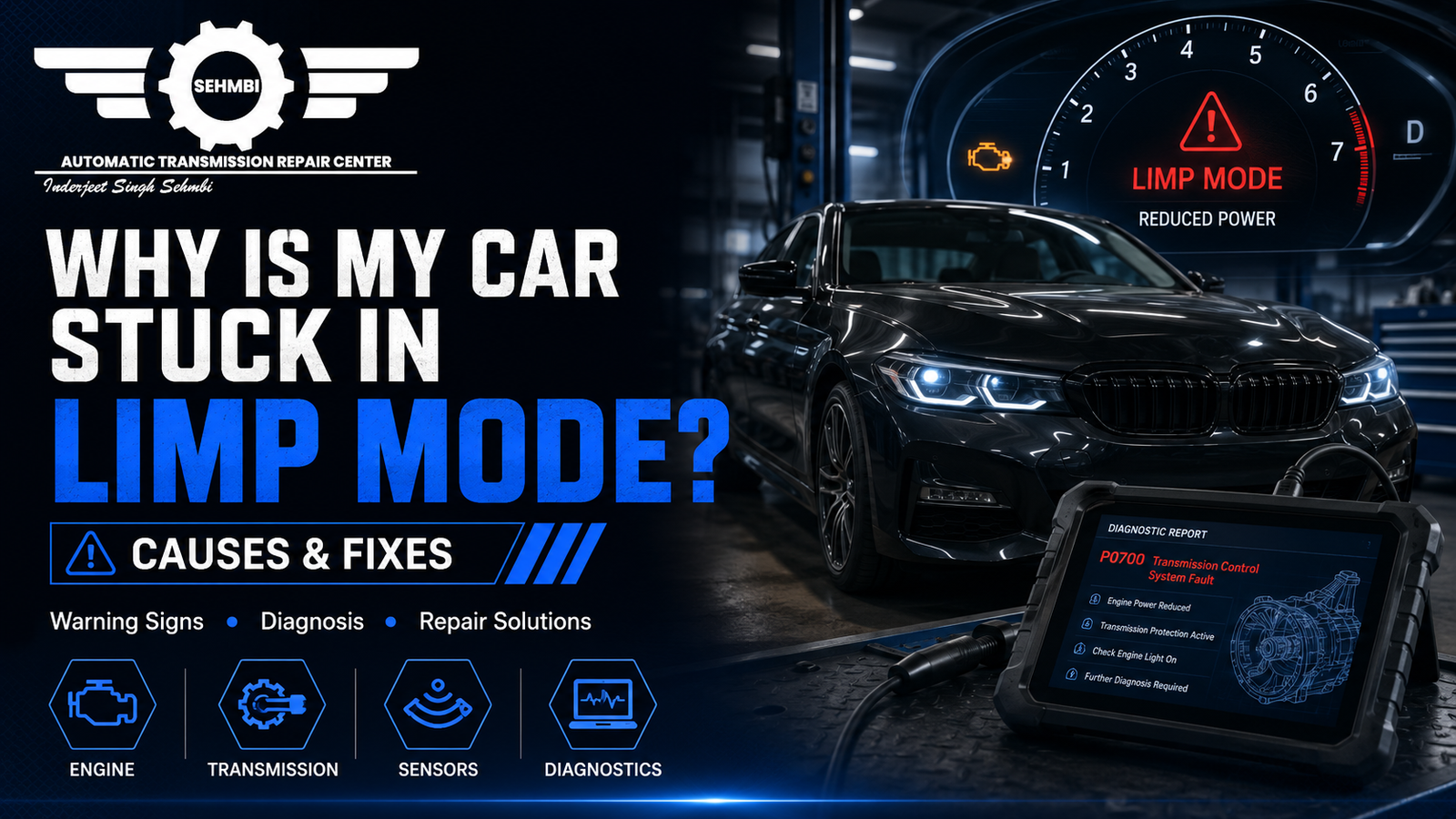
A car enters limp mode when its engine or transmission control system detects a fault that could cause further damage. Common causes include low transmission fluid, faulty sensors, overheating, damaged wiring, solenoid failure, turbocharger problems and transmission-control faults. A computerized diagnostic scan is required to identify the exact cause.
If you are asking, “Why is my car stuck in limp mode?”, avoid repeatedly resetting the warning without diagnosis. Restarting the vehicle may temporarily restore normal performance, but limp mode will usually return until the underlying fault is repaired.
What Is Limp Mode in a Car?
Limp mode, also known as fail-safe or limp-home mode, is a protective function built into modern vehicles. It limits engine power, vehicle speed, RPM or available gears when the control system detects a critical fault.
Manufacturer guidance explains that transmission limp-home mode may activate when the vehicle detects a condition that could result in transmission damage.
In automatic transmission limp mode, the gearbox may remain in second or third gear. This is why drivers may experience a car stuck in one gear, a transmission stuck in third gear or a vehicle that will not shift normally.
Limp mode is not the actual problem. It is the vehicle’s response to an engine, transmission, electrical or emission-system fault.
Common Symptoms of Limp Mode
A car stuck in limp mode may show one or more of these symptoms:
- Check-engine or gearbox warning light
- Reduced engine power warning
- Car losing power while driving
- Car not accelerating properly
- Vehicle unable to exceed a limited speed
- Gearbox stuck in one gear
- Harsh or delayed shifting
- Turbo boost becoming unavailable
- Engine RPM being restricted
- Transmission overheating warning
A car in limp mode but with no warning light is also possible. An intermittent wiring, sensor or communication fault may temporarily restrict performance without keeping the warning light continuously illuminated.
What Causes Limp Mode in a Car?
The exact cause can only be confirmed through fault-code scanning, live-data analysis and physical inspection. However, the following problems commonly trigger limp mode.
1. Low or contaminated transmission fluid
Limp mode due to low transmission fluid can occur when the gearbox cannot maintain correct hydraulic pressure.
Automatic transmission fluid supports lubrication, cooling, clutch operation and hydraulic control. Low, contaminated or burnt fluid may result in:
- Slipping gears
- Delayed engagement
- Pressure-control faults
- Overheating
- Harsh shifting
- Transmission limp mode
Incorrect fluid level and contaminated transmission fluid are recognised causes of pressure and shifting problems.
Do not add transmission fluid without identifying the leak and confirming the correct fluid specification. Using the wrong fluid can create additional gearbox problems.
2. Faulty speed, pressure or temperature sensors
A faulty sensor causing limp mode may send incorrect data to the engine control unit or transmission control module.
Important sensors include:
- Input or turbine speed sensor
- Output speed sensor
- Transmission-fluid temperature sensor
- Hydraulic-pressure sensor
- Throttle-position sensor
- Mass airflow sensor
- Turbo boost-pressure sensor
When the control module cannot compare engine speed, gearbox speed and vehicle speed correctly, it may limit shifting to protect the transmission.
3. Shift-solenoid or valve-body problems
Shift and pressure-control solenoids regulate transmission-fluid flow. A failed solenoid, blocked hydraulic passage or electrical circuit problem can prevent the gearbox from selecting the correct gear.
Possible symptoms include:
- Transmission stuck in limp mode
- Vehicle remaining in second or third gear
- Harsh gear changes
- Delayed Drive or Reverse engagement
- Gearbox warning light
- Incorrect gear-ratio fault codes
SEHMBI’s fault-code guidance identifies pressure-control solenoid, valve-body and wiring problems as possible causes of limp-mode activation.
4. Transmission control module or wiring fault
The transmission control module manages gear selection, hydraulic pressure and communication with other vehicle systems.
A transmission control module fault may be caused by:
- Low battery voltage
- Poor grounding
- Water-damaged connectors
- Broken or corroded wiring
- Software or adaptation errors
- Internal module failure
The module should not be replaced based only on a fault code. Power supply, communication circuits, wiring and sensor inputs must be tested first.
5. Weak battery or charging-system problems
A vehicle may enter limp mode after battery replacement or when battery voltage becomes unstable.
Possible causes include:
- Weak battery
- Loose battery terminals
- Charging-system fault
- Poor ground connection
- Adaptation values being lost
- Temporary control-module communication error
A bad battery can contribute to limp mode, but the battery, alternator, grounds and stored fault codes should all be checked.
6. Engine, throttle-body or turbocharger faults
Limp mode is not always caused by the transmission.
A turbo problem causing limp mode may involve:
- Turbo overboost or underboost
- Split boost hose
- Faulty turbo actuator
- Boost-pressure sensor problem
- Vacuum leak
A throttle body limp mode condition may occur when the accelerator-pedal position and throttle-position signals do not match.
Fuel-pressure, airflow, ignition and emission-system faults can also cause a reduced engine power warning.
7. Engine or transmission overheating
Limp mode after overheating may be activated when engine coolant or transmission-fluid temperature exceeds a safe operating range.
Automatic transmission over-temperature faults can cause fail-safe operation to protect internal components.
Possible causes include:
- Low coolant
- Low transmission fluid
- Blocked transmission cooler
- Cooling-fan failure
- Radiator problems
- Heavy stop-and-go driving
- Excessive towing or load
If the temperature warning appears, stop the vehicle safely and allow it to cool. Continued driving may damage seals, clutch packs and internal components.
Limp Mode Symptom and Diagnosis Guide
| Symptom |
Possible cause |
Recommended action |
| Car stuck in third gear |
Transmission fail-safe mode |
Scan the TCM for fault codes |
| Reduced acceleration |
Engine, throttle or turbo fault |
Check live engine and boost data |
| Limp mode after overheating |
Cooling or transmission-temperature fault |
Stop driving and inspect the cooling system |
| Limp mode after battery change |
Low voltage or adaptation issue |
Test the battery, alternator and communication |
| Jerking with gearbox warning |
Solenoid, valve body or clutch problem |
Arrange transmission diagnosis |
| Limp mode keeps returning |
Underlying fault remains unresolved |
Diagnose stored and pending codes |
How Do I Get My Car Out of Limp Mode?
Drivers often search for how to fix limp mode or how to reset limp mode without a scanner.
You can take these immediate steps:
- Move the vehicle to a safe location.
- Switch off the engine.
- Check for overheating, fluid leakage or a burning smell.
- Inspect the battery terminals for looseness.
- Allow the vehicle to cool.
- Restart it once.
- Arrange a diagnostic scan if limp mode remains or returns.
An ECU limp mode reset may temporarily clear the restriction, but it does not repair the underlying fault. Repeatedly disconnecting the battery or deleting codes can remove valuable diagnostic information.
Can I Drive My Car While It Is in Limp Mode?
A short journey to a safe location may be possible when there is no overheating, severe noise, major fluid leakage or red warning light.
Stop driving and arrange recovery when you notice:
- Burning smell
- Heavy transmission-fluid leakage
- Grinding or severe jerking
- Engine or transmission overheating
- Loss of forward or reverse drive
- Repeated stalling
Limp mode is designed for emergency movement, not continued everyday driving.
How Is Limp Mode Diagnosed?
A professional limp mode diagnostic test should include:
- Engine and transmission fault-code scanning
- Stored, pending and historical-code analysis
- Live sensor-data checks
- Battery-voltage and charging-system tests
- Wiring and connector inspection
- Transmission-fluid level and condition checks
- Solenoid or hydraulic-pressure testing
- Road testing after repairs
A fault code identifies the affected system, but it does not always prove which component has failed.
For transmission-related symptoms, read the guide to signs your automatic gearbox needs immediate repair.
You can also learn how to select a qualified automatic gearbox repair specialist.
How Much Does It Cost to Fix Limp Mode?
The cost depends on the actual cause, not the limp-mode warning itself.
A loose connector, weak battery or sensor fault may cost considerably less than:
- Valve-body repair
- Solenoid replacement
- Mechatronic repair
- Torque-converter work
- Clutch-pack replacement
- Complete gearbox overhaul
For estimated gearbox-related expenses, read the automatic transmission repair cost in Mumbai.
Transmission Limp Mode Repair in Mumbai
SEHMBI Automatic Transmission Repair Center provides automatic gearbox diagnosis, repair, rebuilding, overhaul and replacement support for DSG, DCT, CVT, AMT, ZF and torque-converter transmissions. The centre states that it has served vehicle owners since 1980.
Service coverage published on its vehicle-service pages includes Malad, Borivali, Dahisar, Goregaon, Jogeshwari, Bandra, Andheri, Thane, Navi Mumbai and other Mumbai locations.
Car Stuck in Limp Mode in Mumbai?
Avoid repeated resets and unnecessary part replacement. Book a computerized engine and transmission diagnosis to identify the exact fault.
Call SEHMBI: +91 98337 71779
Frequently Asked Questions
Why is my automatic car stuck in limp mode?
The vehicle may have detected low transmission pressure, faulty sensors, solenoid failure, overheating, wiring problems or internal gearbox damage.
Why is my car stuck in third gear?
Many automatic transmissions select one safe gear during limp mode to reduce shifting and prevent further internal damage.
Can low transmission fluid cause limp mode?
Yes. Low fluid can reduce hydraulic pressure, increase heat and affect clutch and solenoid operation.
Can a bad battery cause limp mode?
Yes. Low voltage or poor electrical connections can interrupt communication between control modules and sensors.
Why does limp mode keep coming back?
The underlying fault has not been repaired. Restarting the vehicle or clearing codes may only remove the restriction temporarily.
Why does my car enter limp mode when accelerating?
Possible causes include turbo-pressure faults, fuel-delivery problems, throttle errors, overheating or transmission slipping under load.
Should I visit a transmission specialist?
Visit a specialist when limp mode occurs with slipping, jerking, delayed engagement, gearbox warnings or the vehicle remaining in one gear.