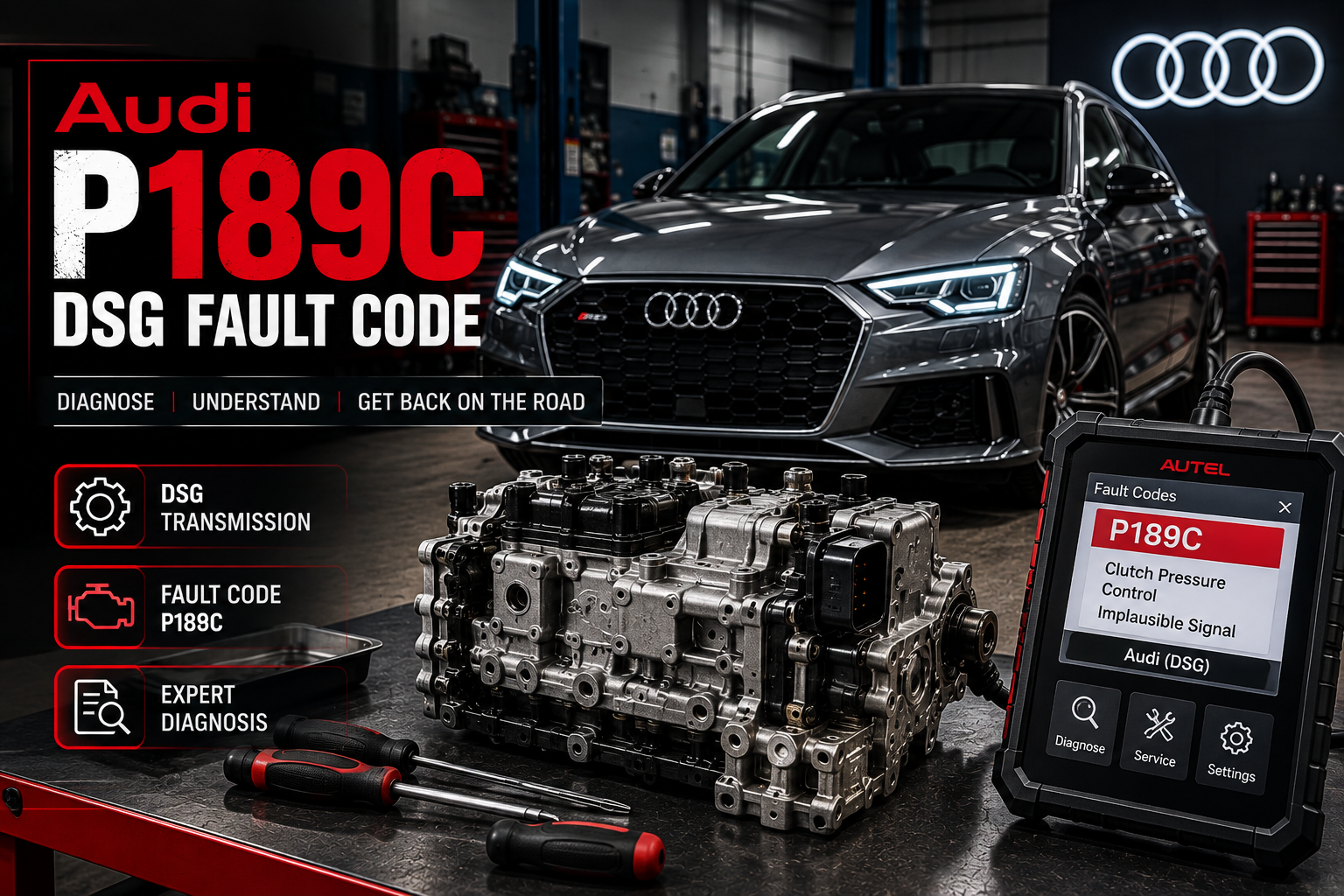
If your Audi is showing the P189C DSG fault code, a gearbox warning message, flashing gear indicator, delayed engagement, or sudden limp mode, the problem may be related to insufficient hydraulic pressure inside the DSG/S tronic transmission control system.
The good news is that Audi P189C does not automatically mean that the complete gearbox needs replacement. The fault can be related to wiring, electrical connections, fuses, hydraulic pump operation, or the mechatronic unit itself.
For Audi owners in Mumbai, accurate diagnosis is especially important before approving an expensive Audi P189C repair or complete mechatronic replacement.
If your Audi is already experiencing repeated gearbox problems, SEHMBI’s Audi Automatic Transmission Repair in Mumbai service page explains the transmission symptoms and Audi gearbox services available in Mumbai.
Quick Answer: What Does Audi P189C Mean?
P189C means “Function Restriction Due to Insufficient Pressure Build-Up.”
The DSG/S tronic transmission relies on hydraulic pressure to control gear selection, clutch engagement, and mechatronic functions. When the system cannot build the required pressure correctly, the transmission control module may store P189C and restrict gearbox operation.
According to the Ross-Tech P189C diagnostic reference, possible causes include faulty wiring, faulty connections, faulty fuses, and problems involving the mechatronic unit or hydraulic pump motor.
What Is the Audi P189C DSG Fault Code?
The Audi P189C DSG fault code is associated with a hydraulic pressure build-up problem inside applicable Volkswagen Group dual-clutch transmission systems.
A DSG/S tronic gearbox requires controlled hydraulic pressure for:
- Gear selection
- Clutch engagement
- Shift control
- Solenoid operation
- Mechatronic functions
- Transmission adaptation
When that pressure cannot be generated within the expected operating parameters, the transmission control module may activate a protection strategy.
This can result in warning lights, restricted shifting, delayed gear engagement, or transmission limp mode.
Audi owners dealing with another pressure-related DSG code can also read the Audi P17BF DSG Fault Code: Symptoms, Causes & Repair Guide to understand how DSG pressure and mechatronic problems can produce similar driving symptoms.
Common Symptoms of Audi P189C
Symptoms can vary depending on the severity of the hydraulic or electrical problem.
Common signs of an Audi P189C DSG fault code include:
- Audi gearbox warning light
- Transmission malfunction message
- PRNDS or gear indicator flashing
- Jerky gear changes
- Delayed Drive engagement
- Delayed Reverse engagement
- Vehicle stuck in one gear
- Failure to select Drive or Reverse
- Sudden loss of drive
- Harsh shifting
- DSG limp mode
- Basic Settings failing to complete
- P189C returning after fault clearing
Ross-Tech notes that P189C can also be associated with Basic Settings not completing successfully and the transmission fault remaining stored after clearing attempts.
If the Audi repeatedly enters emergency operation, understanding why a car gets stuck in limp mode can also help owners understand why modern transmission control modules restrict gearbox operation when a serious fault is detected.
What Causes Audi P189C?
P189C should not be diagnosed simply by replacing parts.
The transmission must be tested systematically because several electrical and hydraulic problems can produce DSG insufficient pressure build-up.
1. Faulty Wiring
Damaged wiring can interrupt power or communication to the transmission mechatronic system.
Possible problems include:
- Broken wires
- Heat-damaged insulation
- Loose terminals
- Corroded connections
- Poor grounding
- Damaged transmission harness
Because wiring repairs can be significantly simpler than replacing a complete mechatronic unit, wiring and electrical supply should be checked early in the diagnostic process.
2. Faulty Electrical Connections
Loose, damaged, or contaminated connectors can prevent the hydraulic pump or mechatronic system from receiving a reliable electrical supply.
Technicians should inspect:
- Mechatronic connector pins
- Transmission wiring connectors
- Ground points
- Power supply terminals
- Connector locking mechanisms
- Moisture or corrosion
The Ross-Tech P189C reference specifically lists faulty electrical connections among possible causes of insufficient pressure build-up.
3. Faulty Fuse or Power Supply
A damaged fuse or interrupted transmission power supply can prevent the DSG hydraulic system from operating normally.
Battery and charging-system voltage should also be evaluated because the transmission control system depends on stable electrical power.
On relevant 7-speed DSG/0AM applications, Ross-Tech also advises checking the required battery power supply to the transmission connector during diagnosis.
4. DSG Hydraulic Pump Motor Problem
The hydraulic pump creates the pressure required for gearbox operation.
If the pump motor becomes weak, operates intermittently, or cannot generate pressure quickly enough, the transmission may register DSG insufficient pressure build-up.
Possible symptoms can include:
- Delayed gear selection
- Loss of Drive
- Loss of Reverse
- Repeated gearbox warning
- Limp mode
- Basic Settings failure
Pump performance should therefore be tested instead of assuming that the complete mechatronic assembly has failed.
5. Audi Mechatronic Fault
An Audi mechatronic fault is another possible cause of P189C.
The mechatronic system combines electronic control and hydraulic components to manage clutch and gear operation.
A problem may involve:
- Hydraulic pump operation
- Internal hydraulic pressure
- Solenoid control
- Electrical circuitry
- Pressure regulation
- Internal mechatronic components
However, P189C alone is not sufficient evidence to justify complete mechatronic replacement.
Audi P189C Diagnosis: Cause vs Test vs Repair
| Possible Cause |
How It Is Checked |
Possible Repair |
| Faulty wiring |
Visual inspection and electrical testing |
Wiring repair |
| Loose/corroded connector |
Connector and pin inspection |
Clean, repair or replace |
| Faulty fuse |
Fuse and power-supply testing |
Replace after finding root cause |
| Unstable electrical supply |
Battery and charging-system test |
Electrical/battery repair |
| Hydraulic pump fault |
Pump-operation and diagnostic testing |
Pump/mechatronic repair |
| Mechatronic fault |
Scan, electrical and hydraulic assessment |
Repair or replacement |
| Internal pressure problem |
Transmission and pressure assessment |
Hydraulic/mechanical repair |
This diagnostic approach is important because it helps prevent expensive parts from being replaced without confirming the actual failure.
Is P189C Always an Audi Mechatronic Fault?
No. P189C does not automatically mean that the Audi mechatronic unit has failed.
A failed mechatronic or hydraulic pump can cause the fault, but wiring, electrical connections, fuses, and power-supply problems must also be investigated.
A logical diagnostic sequence is:
- Scan the transmission control module.
- Confirm P189C.
- Check for additional DSG fault codes.
- Identify the exact transmission fitted.
- Test battery and charging voltage.
- Inspect transmission fuses.
- Check wiring and connectors.
- Verify mechatronic power supply.
- Evaluate hydraulic pump operation.
- Analyse available transmission live data.
- Assess the mechatronic unit if required.
- Perform applicable Basic Settings after successful repair.
Volkswagen owners encountering the same code can see SEHMBI’s detailed P189C Volkswagen DSG Fault Code guide for additional information about DSG pressure diagnosis and repair options.
Can Audi P189C Cause Limp Mode?
Yes.
When the transmission control module cannot rely on stable hydraulic pressure, it may restrict gearbox operation to protect the transmission.
The Audi may:
- Stay in one gear
- Restrict available gears
- Refuse Drive or Reverse
- Shift harshly
- Display a gearbox warning
- Enter emergency or limp mode
Limp mode should not be considered normal operation. It is a protection strategy indicating that the transmission requires diagnosis.
Can You Drive an Audi With P189C?
Continued driving is not recommended if the Audi is showing significant gearbox symptoms.
Stop driving and arrange professional diagnosis if you experience:
- Loss of Drive
- Loss of Reverse
- Severe transmission jerking
- Repeated limp mode
- Flashing gear indicator
- Significant slipping
- Sudden loss of acceleration
- Persistent gearbox malfunction warning
Continuing to drive with unreliable hydraulic pressure could eventually leave the transmission unable to engage a gear.
How Is Audi P189C Diagnosed Professionally?
A transmission specialist should use Audi/VAG-compatible diagnostic equipment such as ODIS, VCDS, or another professional diagnostic system suited to the vehicle.
Step 1: Complete Transmission Scan
P189C should be read together with any additional transmission fault codes.
Pump, voltage, pressure, clutch, or communication codes can provide valuable clues about the root cause.
Step 2: Battery and Charging-System Test
Battery condition and alternator output should be checked to make sure the mechatronic system receives stable voltage.
Step 3: Fuse and Power-Supply Inspection
Transmission fuses and electrical feeds should be tested before expensive gearbox components are removed.
Step 4: Wiring and Connector Inspection
Technicians should inspect the transmission wiring harness, connector pins, grounds, and electrical terminals.
Step 5: Hydraulic Pump Assessment
Pump behaviour should be evaluated to determine whether the transmission is generating pressure correctly.
Step 6: Mechatronic Assessment
If the electrical system is operating correctly, the diagnosis can move toward hydraulic and internal mechatronic components.
Step 7: Basic Settings After Repair
After the actual fault has been successfully repaired, fault codes should be cleared and applicable DSG Basic Settings/adaptation procedures completed.
The Ross-Tech technical reference for P189C/006300 also recommends clearing faults and performing Basic Settings after an effective repair where applicable.
Basic Settings should not be treated as a replacement for repairing an active electrical, hydraulic, or mechanical fault.
Audi P189C Repair Solutions
The correct Audi P189C repair depends on diagnostic findings.
Wiring or Connector Repair
When damaged wiring, loose terminals, or poor connections are responsible, repairing the electrical circuit may restore gearbox operation without mechatronic replacement.
Fuse or Electrical Repair
A failed fuse or incorrect electrical supply must be corrected after identifying why the circuit failed.
Hydraulic Pump or Mechatronic Repair
If diagnostic testing confirms that the pressure-generation system is faulty, specialist hydraulic pump or mechatronic repair may be possible.
Mechatronic Replacement
When internal damage is severe and the mechatronic assembly cannot be economically repaired, replacement may be required.
Correct compatibility, setup, adaptation, and Basic Settings may be required after replacement.
Additional Gearbox Repair
If the diagnostic process discovers clutch wear or internal transmission damage in addition to P189C, further DSG/S tronic repair may be necessary.
However, the P189C code alone does not prove that the complete gearbox needs replacement.
Audi P189C Repair Cost in Mumbai
There is no single fixed Audi P189C repair cost because the final amount depends entirely on the confirmed cause.
The repair may involve:
- Diagnostic scanning
- Wiring repair
- Connector repair
- Fuse replacement
- Electrical-supply repair
- Hydraulic pump repair
- Mechatronic repair
- Complete mechatronic replacement
- Additional clutch repair
- Internal transmission repair
A minor electrical repair and an internal mechatronic failure can have very different costs.
For this reason, a proper diagnostic inspection should always come before a repair quotation.
Audi DSG Repair in Mumbai
If you are searching for Audi DSG repair Mumbai, diagnosis should come before expensive parts replacement.
SEHMBI Automatic Transmission Repair Center provides automatic transmission diagnosis and repair services for Audi vehicles. The dedicated Audi Automatic Transmission Repair Center in Mumbai page covers Audi gearbox problems including transmissions stuck in limp mode, vehicles that will not engage gear, and other automatic gearbox issues.
Services relevant to Audi P189C may include:
- Computerized Audi gearbox diagnosis
- DSG/S tronic fault-code scanning
- Mechatronic assessment
- Hydraulic-pressure diagnosis
- Transmission electrical inspection
- Automatic gearbox repair
- Transmission rebuilding
- Clutch and internal gearbox assessment
SEHMBI states that it has specialised in automatic transmission diagnosis and repair since 1980 and offers services for DSG, DCT, CVT, ZF, AMT, torque-converter, and other automatic transmissions.
Why Choose SEHMBI for Audi DSG Diagnosis?
For a pressure-related code such as P189C, the important question is not simply “Which component should be replaced?”
The correct question is:
“Why is the transmission unable to build the required pressure?”
SEHMBI focuses specifically on automatic gearbox diagnosis and repair rather than general vehicle servicing. Its transmission services include computer diagnosis, mechatronic assessment, gearbox rebuilding, and fault-code diagnosis.
The workshop also states that repairs are backed by a 1-year unlimited-kilometre warranty.
Audi Showing P189C or a Gearbox Warning Light?
Get the transmission professionally diagnosed before approving complete mechatronic or gearbox replacement.
Frequently Asked Questions
What does P189C mean on an Audi?
P189C means Function Restriction Due to Insufficient Pressure Build-Up. The transmission has detected that the expected hydraulic pressure is not building correctly.
What causes Audi P189C?
Potential causes include faulty wiring, electrical connections, fuses, power-supply problems, hydraulic pump motor faults, or an internal mechatronic problem.
Is P189C always an Audi mechatronic fault?
No. Electrical supply, wiring, connectors, and fuses should be tested before concluding that the complete mechatronic unit has failed.
Can a weak battery cause P189C?
Unstable or inadequate voltage can affect DSG/mechatronic operation, which is why battery and charging-system testing should form part of the diagnostic process. The exact cause still needs to be confirmed through testing.
Can P189C trigger an Audi gearbox warning light?
Yes. DSG insufficient pressure build-up can trigger a transmission malfunction warning and may cause restricted gearbox operation.
Can P189C put an Audi into limp mode?
Yes. If the transmission cannot maintain reliable hydraulic operation, the control system may restrict shifting and activate emergency mode.
Can I clear P189C and continue driving?
Clearing the code does not repair the underlying problem. If the pressure, electrical, hydraulic, or mechatronic issue remains, P189C is likely to return.
Does P189C mean my Audi needs a new gearbox?
No. P189C alone does not prove complete gearbox failure. Some vehicles may only require wiring, electrical, pump, hydraulic, or targeted mechatronic repair.
What is the difference between P189C and P17BF?
Both faults can appear in DSG pressure/mechatronic diagnostic work, but they represent different diagnostic conditions. P189C specifically relates to insufficient pressure build-up. Read the Audi P17BF DSG fault code repair guide for a detailed explanation of P17BF.
What happens after Audi P189C is repaired?
After the underlying fault has been successfully corrected, technicians should clear the transmission fault codes and perform the required Basic Settings or adaptation procedures where applicable.