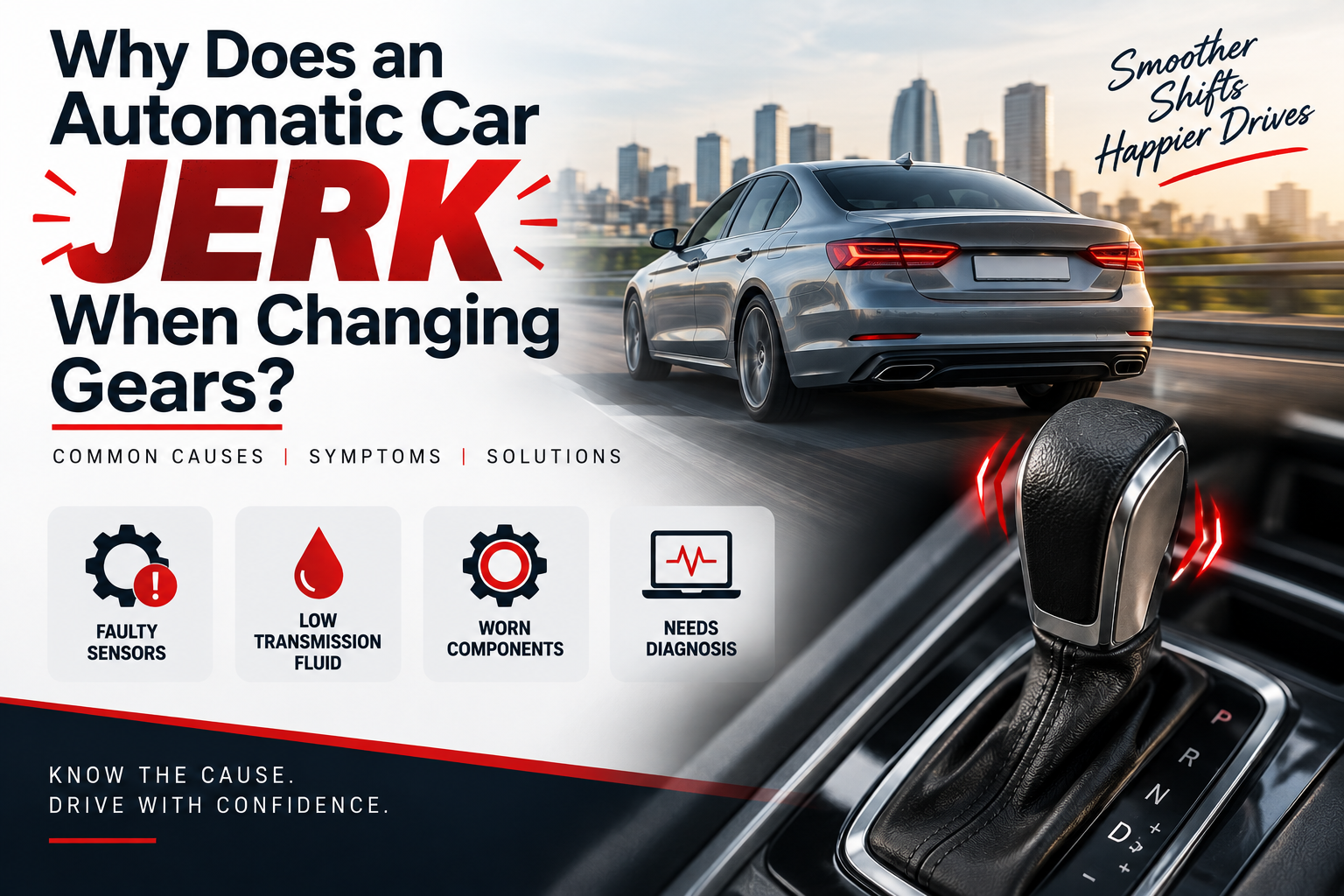
An automatic car should normally change gears smoothly. If you suddenly feel a noticeable jerk, shudder, hesitation, or hard engagement while the transmission shifts, it can be an early indication that something in the gearbox, transmission fluid system, electronic controls, clutch system, or mechatronic unit requires attention.
Automatic car jerking while changing gears may happen occasionally when the vehicle is cold, but repeated jerking especially when accelerating, slowing down, selecting Drive or Reverse, or driving in traffic—should not be ignored.
The cause can range from degraded transmission fluid or an adaptation issue to faulty solenoids, clutch wear, hydraulic pressure problems, or internal transmission damage.
For drivers regularly experiencing rough shifts, our guide to 7 signs your automatic gearbox needs immediate repair explains other warning signs that may appear alongside jerking.
Quick Answer: Why Does an Automatic Car Jerk While Changing Gears?
An automatic car may jerk during gear changes when the transmission cannot engage the next gear smoothly.
Possible causes include:
- Low or degraded transmission fluid
- Incorrect transmission fluid level
- Faulty transmission solenoids
- Hydraulic pressure problems
- Worn clutch packs
- DSG clutch or mechatronic problems
- Transmission adaptation issues
- Worn engine or gearbox mounts
- Sensor or electronic control faults
- Internal transmission wear
The exact cause depends on the gearbox design and when the jerking occurs.
A conventional torque-converter automatic, DSG/DCT, CVT, and AMT transmission operate differently, so diagnosis should identify the transmission type before any repair is recommended.
Is Automatic Transmission Jerking Normal?
A very slight change in drivetrain feel may occasionally be noticeable, but strong, repeated, or worsening automatic transmission jerking should not be considered normal.
Modern automatic transmissions are designed to provide controlled gear engagement.
If your car jerks during gear shift frequently, especially once the transmission is warm, it is worth having the gearbox professionally diagnosed.
Warning signs become more serious when jerking appears together with:
- Delayed gear engagement
- Gear slipping
- High RPM without matching acceleration
- Gearbox warning light
- Transmission overheating
- Loss of Drive or Reverse
- Unusual gearbox noises
- Limp mode
SEHMBI’s automatic transmission repair problems and expert solutions guide provides a broader explanation of rough shifting, slipping, overheating, and other common gearbox faults.
Common Reasons an Automatic Car Jerks When Changing Gears
1. Low or Incorrect Transmission Fluid Level
Transmission fluid performs several important functions inside many automatic gearboxes.
Depending on transmission design, fluid can help with:
- Lubrication
- Cooling
- Hydraulic pressure
- Clutch operation
- Valve-body operation
- Smooth gear engagement
An incorrect fluid level can affect transmission behaviour and may result in rough shifting, slipping, delayed engagement, or jerking.
ZF explains that transmission oil does more than lubricate it also contributes to cooling, contamination protection, and transmission control functions. You can read more in the ZF transmission oil maintenance guidance.
However, transmission fluid should not simply be topped up or changed without identifying the gearbox specification and correct fluid procedure.
Some transmissions require fluid-level checking at a defined operating temperature.
2. Old or Contaminated Transmission Fluid
Transmission fluid deteriorates over time due to heat, mileage, clutch material, and normal internal wear.
When fluid condition worsens, lubrication and hydraulic performance can also deteriorate.
Possible symptoms may include:
- Rough gear changes
- Jerking
- Shuddering
- Delayed engagement
- Slipping
- Increased transmission temperature
ZF recommends regular transmission oil maintenance for automatic, dual-clutch, and CVT transmissions to help maintain expected shift characteristics and driving comfort.
If your vehicle is due for maintenance, use the manufacturer-recommended fluid specification and service procedure rather than assuming one fluid suits every gearbox.
3. Faulty Transmission Solenoids
Modern automatic transmissions use electrically controlled solenoids to regulate fluid pressure and gear engagement.
If a shift or pressure-control solenoid operates incorrectly, the gearbox may apply a clutch or gear too quickly, too slowly, or with incorrect hydraulic pressure.
This can make the car jerk during gear shift.
Possible accompanying symptoms include:
- Hard shifts
- Delayed shifts
- Gearbox warning light
- Transmission stuck in one gear
- Irregular shifting
- Limp mode
ZF notes that pressure-control valves within a mechatronic system control oil pressure used to engage and disengage transmission clutches and brakes. A pressure-regulation fault can therefore result in poor gear engagement or gears failing to engage correctly.
4. Worn Internal Clutch Packs
Many automatic transmissions rely on internal friction clutches to transfer power and engage different gears.
As these components wear, clutch engagement may become less smooth.
Possible symptoms include:
- Jerking during acceleration
- Shuddering
- Transmission slipping
- RPM flare between shifts
- Harsh gear engagement
- Delayed Drive or Reverse
Clutch wear must be diagnosed properly because similar symptoms can also be caused by hydraulic, electrical, or control-system faults.
Replacing a clutch pack without confirming the cause can result in unnecessary repair costs.
5. DSG Clutch or Mechatronic Problems
If your vehicle uses a dual-clutch gearbox, DSG jerking at low speed can involve a different set of components compared with a traditional torque-converter transmission.
A DSG uses two clutch-controlled gearbox sections.
Volkswagen explains that DSG transmissions use two separate gearbox units and alternating clutch engagement, while a mechatronics module controls the gearbox using electronics, sensors, and hydraulic actuators. Read the Volkswagen DSG technical overview for the manufacturer’s explanation.
Problems affecting smooth clutch engagement can involve:
- DSG clutch wear
- Incorrect clutch adaptation
- Mechatronic faults
- Hydraulic pressure problems
- Pressure-control solenoids
- Sensors
- Dual-mass flywheel issues
If your Volkswagen DSG is jerking, read our Volkswagen automatic transmission repair guide for common DSG symptoms and repair options.
Why Does a DSG Jerk at Low Speed?
DSG jerking at low speed is often more noticeable because a dual-clutch gearbox physically engages and disengages clutch packs while moving through low gears.
Traffic crawling, parking manoeuvres, repeated first-to-second gear changes, and stop-start driving require frequent clutch operation.
If clutch engagement, adaptation, hydraulic pressure, or mechatronic control is no longer operating correctly, the driver may notice:
- Judder while starting
- Jerking from 1st to 2nd gear
- Shuddering while crawling
- Hard Drive or Reverse engagement
- Hesitation followed by sudden movement
- Vibration under light throttle
Persistent DSG jerking should be diagnosed rather than dismissed as a normal characteristic.
Fault codes can also provide additional clues. For example, some DSG clutch-control faults can result in severe jerking or hard engagement. Our P177D Volkswagen fault code guide explains one such clutch-related diagnostic condition.
6. Transmission Adaptation Problems
Modern automatic transmissions often use adaptive control strategies.
The transmission control module can learn values related to clutch engagement, hydraulic pressure, driver behaviour, and component wear.
After certain repairs, clutch work, mechatronic replacement, battery-related events, or transmission servicing, the gearbox may require a prescribed adaptation or Basic Settings procedure.
Incorrect adaptation can potentially contribute to:
- Jerky engagement
- Harsh shifting
- Unusual clutch behaviour
- Delayed shifting
However, resetting adaptation should not be used as a universal fix.
If a mechanical or hydraulic fault is still present, an adaptation reset will not repair it.
7. Mechatronic or Hydraulic Pressure Problems
In DSG/DCT transmissions, the mechatronic system manages important hydraulic and electronic gearbox functions.
If hydraulic pressure becomes unstable, clutch and gear engagement may become harsh or delayed.
Possible symptoms include:
- DSG jerking
- Gearbox warning light
- Delayed Drive
- Loss of Reverse
- Transmission stuck in gear
- Limp mode
- Failed Basic Settings
If a Volkswagen DSG has pressure-related symptoms and a diagnostic code, our P189C Volkswagen DSG fault code guide explains how insufficient pressure build-up can affect DSG operation.
8. Engine or Gearbox Mount Problems
Not every jerk comes directly from inside the transmission.
Engine and transmission mounts absorb drivetrain movement.
If a mount becomes damaged or excessively worn, normal gear engagement can produce a noticeable thud or jerk inside the cabin.
A technician should therefore distinguish between:
a transmission that is actually shifting harshly
and
a drivetrain moving excessively because of a failed mount.
This is one reason gearbox symptoms should be diagnosed rather than repaired solely based on how the car feels.
9. Sensor or Electronic Control Faults
Automatic transmissions depend on information from multiple electronic systems.
Depending on the vehicle, the transmission control system may use information related to:
- Engine speed
- Vehicle speed
- Throttle position
- Transmission temperature
- Gear position
- Clutch position
- Hydraulic pressure
Incorrect sensor information can affect shift timing or pressure control.
A complete diagnostic scan is therefore an important part of investigating automatic transmission jerking.
Why Does My Gearbox Jerk More in Traffic?
Gearbox jerking in traffic can become more noticeable because city driving involves constant low-speed gear changes.
In Mumbai, stop-start traffic can mean repeated:
- Acceleration
- Braking
- Low-speed crawling
- 1st-to-2nd gear changes
- Clutch engagement
- Drive and Reverse maneuvering
This can expose clutch, adaptation, hydraulic, mount, and mechatronic problems that are less obvious during steady highway driving.
Traffic itself does not automatically mean the gearbox is damaged. But if the vehicle repeatedly jerks, shudders, bangs into gear, or delays engagement, professional diagnosis is advisable.
Automatic Gearbox Jerking: Symptom vs Possible Cause
| Symptom |
Possible Area to Inspect |
| Jerking from 1st to 2nd |
Clutch, solenoid, adaptation or pressure control |
| Jerking when selecting Drive |
Hydraulic pressure, mounts, clutch engagement |
| Jerking when selecting Reverse |
Clutch/mechatronic, mounts or hydraulic control |
| DSG jerking in traffic |
Clutch adaptation, clutch wear, mechatronics |
| Jerking when transmission is hot |
Fluid, pressure control or internal wear |
| Jerking with slipping |
Clutch/friction components or hydraulic pressure |
| Jerking with warning light |
Electronic/mechatronic transmission fault |
| Jerking plus delayed engagement |
Hydraulic, clutch or valve-body issue |
This table should be used as a diagnostic guide not as confirmation that a specific component needs replacement.
How Is Automatic Transmission Jerking Diagnosed?
A professional diagnostic process may include:
1. Road Test
The technician identifies exactly when the jerk occurs:
- Cold or hot
- Accelerating or slowing
- 1st to 2nd shift
- Higher gears
- Drive engagement
- Reverse engagement
- Stop-start traffic
2. Computer Diagnostic Scan
The gearbox control module should be checked for fault codes.
3. Transmission Fluid Inspection
Where applicable, technicians check:
- Fluid level
- Fluid condition
- Leakage
- Correct specification
4. Live Data Analysis
Professional diagnostic equipment can help evaluate gearbox parameters, depending on the vehicle.
5. Clutch and Mechatronic Assessment
DSG/DCT vehicles may require clutch, adaptation, actuator, hydraulic, and mechatronic assessment.
6. Mechanical Inspection
Engine mounts, gearbox mounts, internal components, and related drivetrain parts may also need examination.
Can You Keep Driving If an Automatic Car Is Jerking?
That depends on how severe the symptoms are.
A minor intermittent symptom should still be diagnosed, but you should avoid prolonged driving if you notice:
- Severe jerking
- Transmission slipping
- Burning smell
- Gearbox warning light
- Vehicle stuck in gear
- Loss of Drive or Reverse
- Loud grinding or banging
- Repeated limp mode
Ignoring transmission symptoms can allow an underlying fault to worsen.
ZF also notes that failing to investigate abnormal transmission vibrations, noises, or shifting symptoms can contribute to more significant consequential damage.
Automatic Transmission Repair in Mumbai
If you are searching for transmission repair Mumbai because your automatic car is jerking, the most important step is to diagnose the actual cause before replacing expensive components.
SEHMBI Automatic Transmission Repair Center states that it has specialised in automatic gearbox diagnosis, repair, and rebuilding since 1980, with operations in Mumbai and Bengaluru.
The workshop works with transmission types including:
- DSG
- DCT
- CVT
- ZF automatic transmissions
- AMT
- Torque-converter automatics
You can learn more about its specialist gearbox services through the SEHMBI Automatic Transmission Repair Center.
For vehicles showing repeated jerks, delayed engagement, slipping, or transmission warnings, diagnosis may include:
- Computerized gearbox scanning
- Fluid inspection
- Clutch assessment
- Mechatronic diagnosis
- Hydraulic pressure assessment
- Solenoid diagnosis
- Transmission repair
- Gearbox rebuilding
Why Diagnose Jerking Before Replacing the Gearbox?
A jerking transmission does not automatically mean the complete gearbox has failed.
The cause may be:
- Transmission fluid condition
- Electrical supply
- Solenoid
- Sensor
- Clutch adaptation
- Mechatronic control
- Mount
- Hydraulic pressure
- Internal wear
This is why component replacement should follow diagnosis—not precede it.
If you are worried that a jerking gearbox means complete failure, read are automatic transmissions repairable? to understand why many gearbox faults can be repaired without automatically replacing the entire transmission.
Automatic Car Jerking While Changing Gears in Mumbai?
If your vehicle has started jerking, shuddering, slipping, or shifting harshly, get the gearbox checked before the problem becomes more severe.
Frequently Asked Questions
Why does my automatic car jerk when changing gears?
Automatic car jerking can be caused by transmission fluid problems, faulty solenoids, hydraulic pressure issues, worn clutches, adaptation problems, mechatronic faults, damaged mounts, sensors, or internal gearbox wear.
Is automatic transmission jerking dangerous?
Mild occasional jerking may not indicate immediate failure, but repeated or severe jerking—especially with slipping, warning lights, loss of gear, or limp mode—should be diagnosed promptly.
Why does my car jerk from 1st to 2nd gear?
A 1st-to-2nd gear jerk can be related to clutch engagement, transmission fluid, solenoids, hydraulic pressure, adaptation values, or internal transmission wear.
Why does my DSG jerk at low speed?
DSG gearboxes use clutch packs to engage and disengage power. Low-speed jerking can be associated with clutch wear, adaptation, mechatronic control, hydraulic pressure, or related drivetrain components.
Why is my gearbox jerking more in traffic?
Stop-start traffic creates frequent low-speed shifts and clutch engagement. Existing clutch, adaptation, hydraulic, or mechatronic problems may therefore become more noticeable during crawling traffic.
Can low transmission fluid cause jerking?
Yes. On transmissions where fluid level directly affects hydraulic and clutch operation, an incorrect fluid level can contribute to rough shifting, slipping, or delayed engagement. The correct specification and checking procedure must be followed.
Will changing transmission oil fix jerking?
Sometimes fluid service can improve shifting if poor fluid condition is genuinely the cause. However, jerking caused by clutch wear, solenoids, mechatronics, mounts, sensors, or internal damage will require additional diagnosis and repair.
Can a gearbox jerk without showing a warning light?
Yes. Mechanical wear, mounts, early clutch problems, or developing hydraulic issues may produce symptoms before a warning light appears.
Does jerking mean the gearbox needs replacement?
No. A jerking automatic transmission can have many causes, and several may be repairable without replacing the complete gearbox.
When should I visit a transmission specialist?
Book a diagnostic inspection if jerking becomes frequent, worsens when warm, appears with slipping or delayed gear engagement, triggers a warning light, or causes the vehicle to enter limp mode.