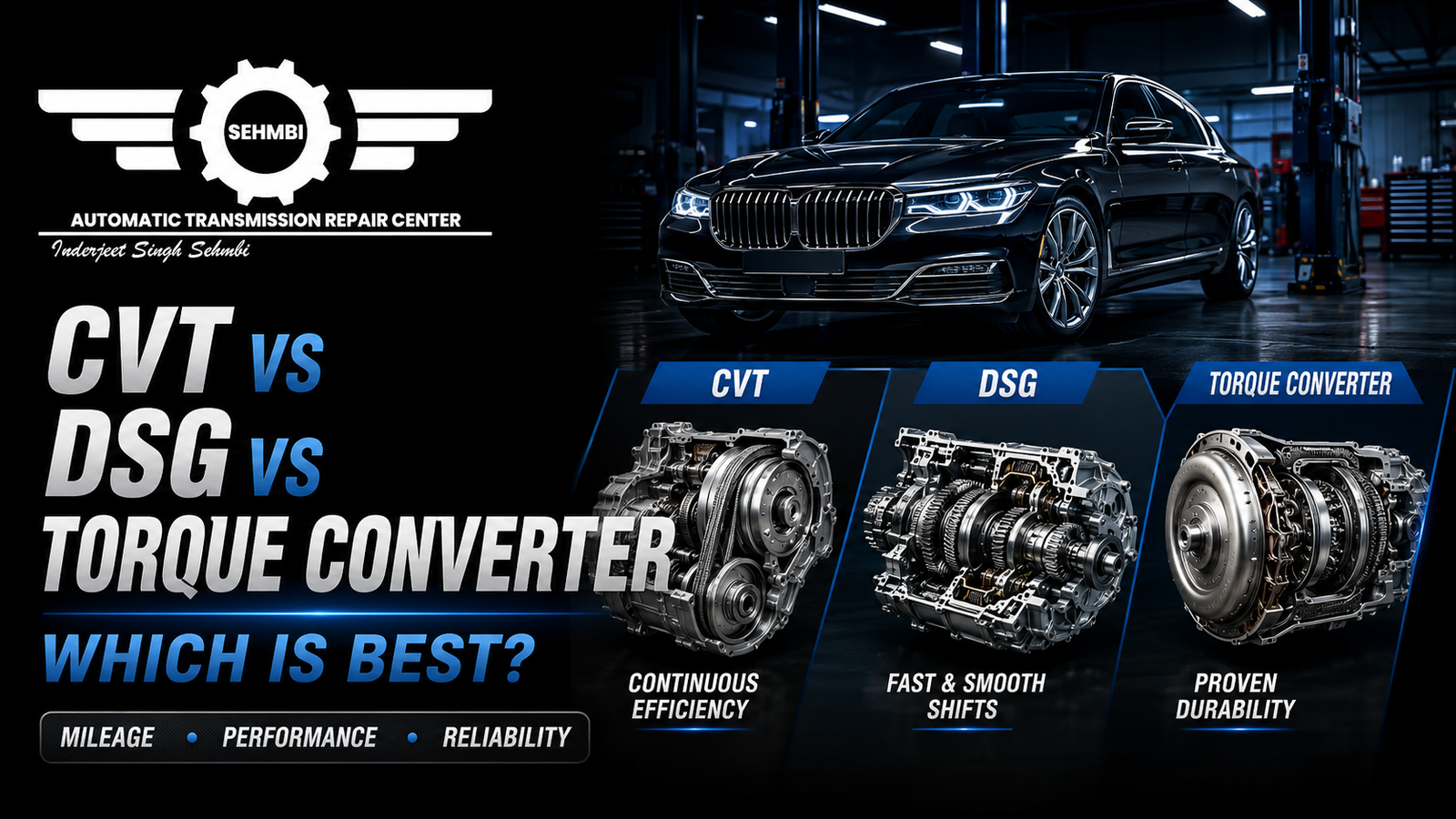
When buying an automatic car, many drivers compare CVT vs DSG vs torque converter transmissions. All three systems change gears automatically, but they provide different levels of comfort, performance, fuel efficiency, reliability and maintenance cost.
A CVT is generally suitable for smooth city driving and mileage. A DSG is designed for quick gear shifts and sporty performance, while a torque-converter transmission offers a balanced combination of comfort, strength and reliability.
So, which automatic transmission is best? The answer depends on your driving style, daily traffic conditions and maintenance budget. This guide explains the difference between CVT, DSG and torque converter transmissions to help you choose the right automatic gearbox.
CVT vs DSG vs Torque Converter: Quick Comparison
| Feature |
CVT |
DSG |
Torque Converter |
| Driving experience |
Smooth and relaxed |
Fast and sporty |
Smooth and balanced |
| City traffic |
Excellent |
Can feel jerky |
Very comfortable |
| Highway performance |
Good |
Excellent |
Very good |
| Fuel efficiency |
Usually high |
Good to high |
Moderate to good |
| Reliability |
Good with maintenance |
More complex |
Generally dependable |
| Repair cost |
Moderate to high |
Usually high |
Moderate to high |
| Best for |
City commuters |
Performance drivers |
Mixed usage |
There is no single winner in the CVT DSG torque converter comparison. Each gearbox suits a different type of driver.
What Is a CVT Transmission?
CVT stands for Continuously Variable Transmission. Unlike a traditional automatic gearbox, it does not use fixed conventional gears. It generally uses a belt or chain with variable pulleys to adjust the transmission ratio continuously.
This design allows the engine to operate efficiently without noticeable gear changes.
CVT transmission advantages
The main CVT transmission advantages include:
- Smooth acceleration
- Good fuel efficiency
- Comfortable stop-and-go driving
- Easy operation for new drivers
- Reduced gear-shift shock
In the CVT vs DSG mileage comparison, CVT often performs well in urban conditions because it keeps the engine within an efficient speed range.
CVT transmission disadvantages
The major CVT transmission disadvantages include:
- Less sporty driving feel
- Engine noise during hard acceleration
- Sensitivity to incorrect transmission fluid
- Expensive belt, pulley or valve-body repairs
- Limited suitability for aggressive driving
The CVT gearbox repair cost can increase significantly when internal pulleys, bearings or belts become damaged. Correct fluid and timely servicing are essential.
For slipping, unusual noise or delayed response, visit an experienced automatic transmission repair specialist in Mumbai.
What Is a DSG Transmission?
DSG stands for Direct-Shift Gearbox. It is a dual-clutch automatic transmission that uses two clutches. One clutch operates odd-numbered gears, while the second manages even-numbered gears.
Because the next gear is already prepared, DSG can deliver extremely fast gear changes.
DSG transmission advantages
The main DSG transmission advantages are:
- Quick and precise gear changes
- Strong acceleration
- Sporty driving experience
- Good highway efficiency
- Direct power delivery
In a DSG vs CVT performance comparison, DSG is usually better for drivers who want responsive acceleration and fast shifts.
DSG transmission disadvantages
The important DSG transmission disadvantages include:
- Jerking in slow-moving traffic
- Heat buildup during prolonged crawling
- Complex clutch and mechatronic systems
- Higher repair expenses
- Need for specialist maintenance
Many owners ask, “Is DSG suitable for Indian traffic conditions?” DSG can perform well when maintained properly, but frequent bumper-to-bumper traffic may place additional stress on certain dry-clutch DSG units.
The DSG gearbox repair cost may be high when the problem involves the clutch pack, mechatronic unit or hydraulic system.
Read the Volkswagen DSG transmission repair guide for common symptoms and repair information.
What Is a Torque Converter Transmission?
A torque-converter transmission uses a fluid coupling between the engine and gearbox. It generally operates through conventional planetary gears and changes ratios automatically.
Modern torque-converter gearboxes provide smoother shifts, better fuel economy and improved performance compared with older automatic transmissions.
Torque converter advantages
The main torque converter advantages include:
- Smooth low-speed movement
- Comfortable operation in traffic
- Strong acceleration
- Good heat tolerance
- Suitability for city and highway driving
- Generally dependable performance
For buyers searching for the best automatic transmission for Indian roads, a torque converter is often a practical all-round option.
Torque converter disadvantages
The common torque converter disadvantages include:
- Lower mileage in some older vehicles
- Slower shifts compared with DSG
- More transmission fluid requirements
- Expensive overhaul after major internal failure
The torque converter repair cost depends on whether the problem is related to the converter, solenoids, valve body or internal clutch components.
CVT vs DSG: Which Is Better?
In the CVT vs DSG comparison, CVT is better for smooth and economical city driving. DSG is more suitable for performance-focused drivers.
Choose CVT when you prioritise:
- Fuel efficiency
- Comfortable city driving
- Smooth acceleration
- Easy daily commuting
Choose DSG when you prioritise:
- Rapid gear shifts
- Strong performance
- Highway driving
- Sporty handling
Therefore, the answer to “Is CVT better than DSG?” depends on usage. CVT is usually better for relaxed commuting, while DSG offers a more exciting driving experience.
DSG vs Torque Converter: Which Is Better?
In the DSG vs torque converter comparison, DSG provides faster gear changes and sharper acceleration. A torque converter usually offers smoother movement in slow traffic and more comfortable everyday driving.
The DSG vs torque converter reliability comparison depends on the vehicle model and maintenance. However, torque-converter transmissions are generally more forgiving in congested traffic.
DSG is better for performance and open-road driving, while a torque converter is better for mixed city and highway use.
CVT vs Torque Converter: Which Is Better?
The CVT vs torque converter comparison mainly comes down to mileage versus versatility.
CVT is usually better for fuel-efficient city commuting. A torque converter offers stronger acceleration, a more conventional driving feel and better performance across varied road conditions.
In the CVT vs torque converter reliability comparison, both can be dependable when serviced correctly. CVT requires strict fluid maintenance, while torque converters often handle heavy traffic and longer journeys more comfortably.
Which Transmission Gives the Best Mileage?
For drivers asking, “Which automatic gearbox gives the best mileage?”, CVT often performs well in city traffic. DSG may provide excellent highway mileage because of its direct power delivery.
Modern torque-converter transmissions have also become more efficient. Actual mileage depends on the engine, vehicle weight, traffic, road conditions and driving habits.
Which Is the Most Reliable Automatic Transmission?
There is no universal most reliable automatic transmission. Reliability depends on gearbox design, maintenance, fluid quality and driving style.
Torque-converter transmissions are often considered dependable for varied usage. CVTs can last well with correct maintenance, while DSG systems can also be reliable but may involve expensive clutch or mechatronic repairs.
To reduce automatic transmission maintenance cost:
- Use the correct gearbox fluid
- Repair leaks immediately
- Avoid ignoring warning lights
- Do not drive aggressively in heavy traffic
- Follow the manufacturer’s service schedule
- Choose a trained transmission specialist
Learn more about the automatic transmission repair cost in Mumbai before approving major servicing or replacement work.
Which Gearbox Is Best for Mumbai Traffic?
For the best automatic transmission for traffic, CVT and torque-converter systems are usually more comfortable than DSG.
A CVT provides smooth, uninterrupted acceleration, while a torque converter offers dependable creeping and low-speed performance. DSG may feel hesitant during prolonged crawling.
The best gearbox for Mumbai traffic depends on the driver:
- CVT: Best for mileage and daily commuting
- Torque converter: Best for comfort and mixed driving
- DSG: Best for performance and highway use
Final Verdict
CVT when fuel efficiency and smooth city driving are your main priorities.
DSG when fast shifts, performance and sporty driving matter most.
Torque converter when you need a comfortable and balanced gearbox for traffic, highways and long journeys.
For many Indian drivers, the torque converter is the best all-round option. However, CVT remains a strong choice for city commuters, while DSG is better suited to driving enthusiasts.
Before purchasing a used automatic car, get the transmission inspected by an automatic gearbox specialist in Mumbai. A diagnostic scan, fluid inspection and road test can identify hidden problems.
Frequently Asked Questions
1) Which is better: CVT, DSG or torque converter?
CVT is best for smooth city driving, DSG is best for performance, and a torque converter is a balanced choice for mixed road conditions.
2) Which automatic transmission is cheaper to repair?
Repair costs depend on the fault. DSG clutch and mechatronic repairs are often expensive, while major CVT and torque-converter repairs can also cost significantly.
3) Which transmission is best for Indian roads?
A torque-converter transmission is generally suitable for Indian roads because it provides smooth operation, durability and comfortable city and highway performance.
4) Is CVT good for long-distance driving?
Yes. A properly maintained CVT can handle long journeys, although DSG or torque-converter gearboxes may provide stronger acceleration.
5) Which automatic gearbox is best for a first-time buyer?
CVT and torque-converter transmissions are generally easier for first-time buyers because they offer smooth and simple operation.
6) When should an automatic gearbox be inspected?
Get the gearbox inspected when you notice jerking, slipping, delayed engagement, overheating, fluid leakage, unusual noise or a transmission warning light.