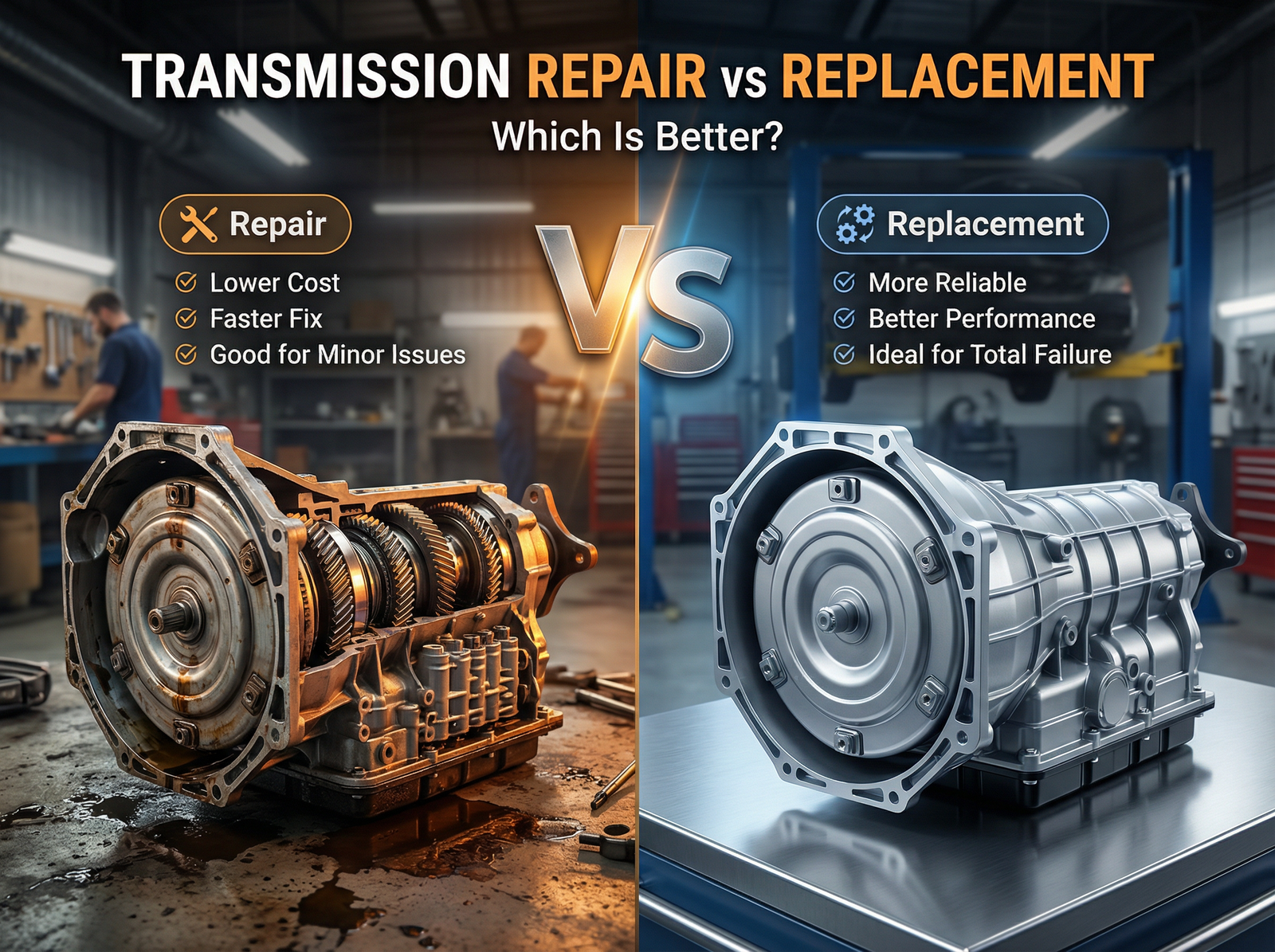
When your car begins to show signs of transmission trouble, one important question comes to mind: transmission repair vs replacement – which is better? This decision can impact your vehicle’s performance, your budget, and long-term reliability.
The transmission is one of the most complex and essential systems in any vehicle. It controls how power is transferred from the engine to the wheels, ensuring smooth gear changes and efficient driving. When it fails, ignoring the issue can lead to serious mechanical damage.
In this guide, we’ll explain the difference between repair and replacement, compare costs, and help you decide whether it’s better to repair or replace your transmission.
What Is Transmission Repair?
Transmission repair involves fixing specific parts of the gearbox rather than replacing the entire system. It is usually the first step when diagnosing transmission problems.
Common repair work may include:
- Fixing fluid leaks
- Replacing worn seals or gaskets
- Repairing or replacing sensors and solenoids
- Adjusting internal components
- Fixing minor clutch or band issues
Repair is generally recommended when the damage is limited and the transmission is still structurally sound.
What Is Transmission Replacement?
Transmission replacement means removing the entire gearbox and installing a new or rebuilt unit. This option is typically chosen when the existing transmission is beyond repair.
There are two main types of replacement:
- New Transmission: Brand-new unit directly from the manufacturer
- Rebuilt Transmission: Reconditioned unit with replaced internal components
Replacement is more expensive but often provides a long-term solution.
When Should You Repair Your Transmission?
Repair is often the best choice when the problem is detected early and the damage is minimal.
Choose repair if:
- The issue is minor or isolated
- The transmission still functions properly
- The vehicle is relatively new
- You want a budget-friendly solution
Common Repairable Issues
- Low or contaminated transmission fluid
- Sensor or electrical faults
- Slight gear slipping
- Delayed shifting
- Minor overheating problems
Fixing these issues early can prevent major transmission failure.
When Should You Replace the Transmission?
Replacement becomes necessary when the transmission has suffered serious internal damage.
Choose replacement if:
- The gearbox has completely failed
- Internal components are heavily worn
- Metal particles are found in the fluid
- Repair costs are close to replacement cost
- The transmission repeatedly fails
In such cases, replacement ensures better performance and reliability.
Transmission Rebuild vs Replacement
Another important option to consider is rebuilding the transmission.
Transmission Rebuild
- Only damaged components are replaced
- Existing transmission housing is reused
- More affordable than full replacement
Transmission Replacement
- Entire transmission unit is replaced
- Provides a fresh start with new or rebuilt components
- More reliable for long-term use
Which Option Is Better?
- Rebuild: Suitable for moderate damage
- Replacement: Ideal for severe or complete failure
Pros and Cons of Each Option
Transmission Repair
Advantages:
- Lower cost
- Faster service
- Ideal for minor problems
Disadvantages:
- May not fix deeper issues
- Risk of future repairs
Transmission Replacement
Advantages:
- Long-term reliability
- Improved performance
- Eliminates recurring issues
Disadvantages:
- High cost
- Longer repair time
- Not always necessary
Signs Your Transmission Needs Attention
Recognizing early warning signs can help you avoid expensive repairs.
Common symptoms include:
- Slipping gears
- Rough or delayed shifting
- Burning smell
- Fluid leaks under the vehicle
- Strange noises from the gearbox
- Reduced vehicle performance
If you notice these signs, it’s important to act quickly and assess whether repair or replacement is needed.
Factors to Consider Before Making a Decision
1. Vehicle Age
- Newer vehicles → Repair is usually better
- Older vehicles → Replacement may not be cost-effective
2. Budget
- Limited budget → Choose repair
- Long-term investment → Consider replacement
3. Severity of Damage
- Minor issues → Repair
- Major failure → Replacement
4. Future Plans
If you plan to keep your car for several years, investing in replacement may be worthwhile.
Expert Advice
Before making a final decision, it’s always best to consult a professional transmission specialist. A proper inspection can help determine the exact issue and recommend the most cost-effective solution.
A qualified expert can:
- Diagnose the root problem
- Estimate repair vs replacement cost
- Suggest the best option based on vehicle condition
Final Verdict: Repair or Replace?
So, which is better transmission repair or replacement?
Simple Answer:
- Choose repair for minor, early-stage issues
- Choose replacement for major or repeated failures
There is no universal answer. The right choice depends on your vehicle’s condition, budget, and long-term goals.
Conclusion
Deciding between transmission repair vs replacement can feel overwhelming, but understanding your options makes the process easier.
Repair is a cost-effective solution for minor issues, while replacement offers a more permanent fix for serious damage. Evaluating the condition of your transmission and seeking professional advice will help you make the best decision.
Taking action early can save you money, prevent breakdowns, and ensure your vehicle continues to perform smoothly for years to come.