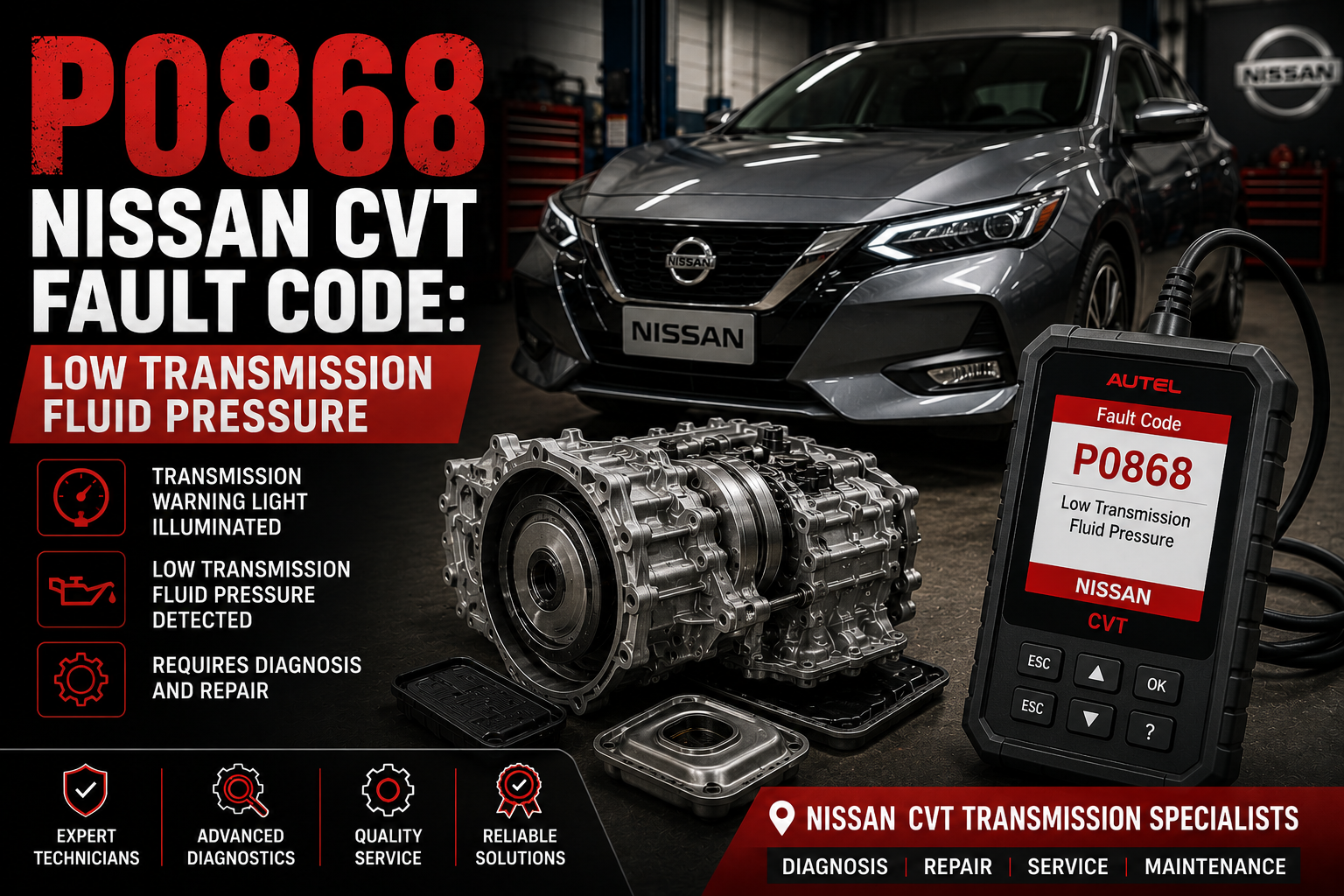
The P0868 Nissan CVT fault code means the transmission control system has detected low transmission fluid pressure. Nissan service information identifies P0868 as “FLUID PRESS LOW”, and this is an important fault because a CVT depends on stable hydraulic pressure to operate the belt or chain, pulleys, valve body, pressure-control system, and ratio changes correctly.
A Nissan P0868 fault code may appear with hesitation, weak acceleration, shuddering, slipping, delayed engagement, a transmission warning light, or Nissan CVT limp mode. However, P0868 does not automatically mean the entire CVT has failed. The real cause may be low fluid, a leak, a pressure-control solenoid issue, valve-body wear, a pump problem, incorrect pressure-sensor data, or internal CVT damage.
Quick Answer: P0868 means the Nissan CVT is seeing fluid pressure below the expected level. Before replacing the transmission, technicians should confirm CVT fluid level, leaks, actual line pressure, pressure-control solenoid operation, valve-body condition, pump output, TCM data, and internal CVT wear.
What Does P0868 Mean on Nissan?
The P0868 Nissan fault code is directly related to transmission fluid pressure. Nissan’s own DTC naming documentation lists P0868 as Transmission Fluid Pressure / Fluid Press Low.
In a CVT, hydraulic pressure is used to control:
- Pulley clamping force
- Belt or chain operation
- Ratio changes
- Forward and reverse engagement
- Valve-body functions
- Pressure-control solenoids
If the Nissan CVT hydraulic pressure becomes too low, the TCM may detect abnormal transmission behaviour and store the P0868 low transmission fluid pressure code.
For another common Nissan CVT fault, read our P17F1 Nissan CVT fault code guide.
Common P0868 Nissan CVT Fault Symptoms
The exact symptoms of a P0868 CVT fault code depend on how severe the pressure loss is.
Common signs include:
- Nissan CVT slipping
- Nissan CVT jerking
- Nissan CVT shudder
- Delayed engagement
- Poor acceleration
- High RPM with weak response
- Nissan CVT not shifting properly
- Transmission warning light
- Check Engine Light
- Nissan CVT overheating
- Nissan CVT gearbox fault
- Nissan automatic transmission fault
- Nissan CVT limp mode
- Reduced power
Nissan issued a bulletin for certain Sentra, Versa Note, and Versa Sedan models where P0868 could occur with hesitation and/or lack of power, confirming that low-pressure faults can cause noticeable drivability issues.
P0868 Nissan CVT Diagnostic Checklist
| Diagnostic Check |
Why It Matters |
| CVT fluid level |
Low fluid can directly reduce hydraulic pressure |
| Fluid condition |
Burnt or contaminated fluid may indicate overheating or wear |
| External leaks |
Helps identify why fluid level is dropping |
| Actual line pressure |
Confirms whether pressure is genuinely low |
| Pressure-control solenoid |
Regulates CVT hydraulic pressure |
| Valve body |
Controls pressure distribution and ratio operation |
| CVT oil pump |
Produces required hydraulic pressure |
| TCM live data |
Compares commanded and actual CVT behaviour |
| Internal belt/chain and pulleys |
Identifies mechanical wear |
Important: P0868 does not automatically mean the Nissan CVT needs replacement. Fluid level, leaks, line pressure, valve body, solenoids, pump output, and internal condition should be checked before major repair is approved.
What Causes P0868 Nissan CVT Fault Code?
1. Low CVT Fluid Level
A Nissan CVT fluid level low condition is one of the first things that should be checked.
If the transmission does not contain enough fluid, the pump may struggle to maintain the hydraulic pressure required for normal operation.
Possible causes include:
- CVT fluid leak
- Loose or damaged cooler line
- Seal leakage
- Incorrect previous service
- Underfilled transmission
Nissan field documentation records a vehicle with low CVT fluid, a loose cooling hose, and a stored P0868 Fluid Press Low code. After fluid was restored and the hose repaired, the transmission operated normally during road testing.
This is why a Nissan CVT fluid leak should always be repaired rather than simply adding fluid.
2. Degraded or Incorrect CVT Fluid
CVT fluid does more than lubricate internal parts; it also supports hydraulic control.
Old, overheated, contaminated, or incorrect fluid can interfere with pressure regulation and transmission operation.
Possible symptoms include:
- Nissan CVT shudder
- Slipping
- Delayed engagement
- Overheating
- Rough ratio changes
For maintenance guidance, read How Often Should You Change Automatic Transmission Oil?.
The exact Nissan CVT fluid specification varies by transmission model, so the correct service fluid should always be used.
3. Nissan CVT Valve Body Problem
A Nissan CVT valve body problem is another important cause to investigate.
The valve body controls hydraulic fluid distribution inside the CVT. If valves stick, wear internally, or leak pressure, the transmission may fail to maintain correct line pressure.
Possible symptoms include:
- Nissan CVT jerking
- Delayed engagement
- Poor acceleration
- Slipping
- Limp mode
- Pressure-related fault codes
A valve-body fault should be confirmed through scan data and pressure testing rather than assumed from P0868 alone.
4. Nissan CVT Solenoid Fault
A Nissan CVT solenoid fault can directly affect pressure control.
Pressure-control solenoids receive commands from the TCM and regulate hydraulic pressure. If a solenoid sticks, becomes electrically faulty, or cannot control fluid flow correctly, actual pressure can fall below the target.
Diagnosis may include:
- Electrical testing
- Solenoid command checks
- TCM live-data analysis
- Hydraulic pressure testing
This is why a pressure control solenoid should be tested before replacing the complete valve body or transmission.
5. Nissan CVT Pump Problem
A Nissan CVT pump problem can also trigger P0868.
The CVT oil pump generates hydraulic pressure for the transmission. If the pump becomes worn or damaged, it may fail to maintain enough pressure during acceleration or when the CVT is hot.
Potential causes include:
- Internal pump wear
- Fluid starvation
- Internal leakage
- Contaminated fluid
- Mechanical pump damage
A weak pump may produce more noticeable symptoms under load because hydraulic demand increases.
6. Transmission Fluid Pressure Sensor Fault
A Nissan CVT fluid pressure sensor fault may also need investigation.
If a pressure sensor provides incorrect data, the TCM may interpret the reading as low pressure even when actual hydraulic pressure is acceptable.
However, sensor replacement should not be the first step. Actual line pressure should be compared with scan-tool data first.
7. Internal CVT Belt, Chain, or Pulley Wear
Severe internal wear can also contribute to a Nissan CVT pressure problem.
The CVT belt or chain and pulley system depends on adequate clamping pressure. If internal components are worn, the transmission may slip, overheat, or require abnormal pressure correction.
Possible symptoms include:
- Severe Nissan CVT shudder
- High RPM
- Slipping under load
- Delayed acceleration
- Metallic contamination
- Persistent P0868
If internal damage is confirmed, the transmission may require rebuilding or replacement.
P0868 vs Related Nissan CVT Fault Codes
Understanding related codes can help build a more accurate diagnosis.
| Fault Code |
Typical Meaning |
| P0868 |
Transmission fluid pressure low |
| P0746 |
Pressure control solenoid performance/stuck off |
| P0841 |
Transmission fluid pressure sensor range/performance |
| P17F0 |
Nissan CVT judder-related fault |
| P17F1 |
Nissan CVT judder-related fault |
Nissan incident documentation has shown P0746 and P0868 appearing together on a CVT with low power, no reverse, and a fluid leak. This shows why related pressure-control codes should be interpreted together.
For more detail on judder faults, see our P17F1 Nissan CVT fault code guide.
Can Low CVT Fluid Cause P0868?
Yes.
Low CVT fluid can reduce hydraulic pressure and is a genuine potential cause of P0868. Nissan documentation shows P0868 appearing after significant CVT fluid loss caused by a loose cooling hose.
However, low fluid should not be assumed to be the only cause.
A logical diagnostic path is:
Low fluid → leak → pressure-control solenoid → valve body → pump → internal CVT wear
This sequence helps reduce the risk of unnecessary transmission replacement.
Can P0868 Cause Nissan CVT Limp Mode?
Yes.
A serious Nissan CVT low pressure fault can cause the TCM to enter a protective or fail-safe strategy.
Possible Nissan CVT limp mode symptoms include:
- Restricted acceleration
- Reduced power
- High RPM
- Poor CVT ratio response
- Transmission warning light
- Limited drivability
If your Nissan repeatedly enters fail-safe operation, read Why Is My Car Stuck in Limp Mode? Causes & Fixes.
Can You Drive With P0868 Nissan Fault Code?
Driving with P0868 is not recommended if the CVT is slipping, shuddering heavily, overheating, losing power, or entering limp mode.
Low hydraulic pressure can reduce pulley clamping force and increase internal CVT wear.
If the car is showing severe symptoms, professional diagnosis is safer than continuing normal daily driving.
How Is P0868 Nissan Diagnosed?
A professional P0868 Nissan diagnosis and repair should include:
- Confirm P0868 using Nissan-compatible diagnostics.
- Record all related CVT codes.
- Check CVT fluid level and condition.
- Inspect cooler lines and seals for leaks.
- Compare commanded and actual pressure data.
- Check actual line pressure where required.
- Test pressure-control solenoids.
- Evaluate valve-body operation.
- Assess CVT pump performance.
- Check TCM data and electrical circuits.
- Inspect internal CVT components if pressure remains low.
Nissan’s own P0868 bulletin uses a defined repair flow and specifically instructs technicians not to assume that one repair applies to every vehicle.
For technicians using Nissan’s factory platform, Nissan CONSULT-III Plus documentation also confirms that Nissan transmission programming and diagnostic procedures depend on correct vehicle conditions, voltage, and communication setup.
P0868 Nissan CVT Repair Options
The correct P0868 fault code fix depends on the confirmed cause.
CVT fluid correction: Appropriate if fluid level or condition is incorrect and no major damage is found.
Leak repair: Required when cooler lines, seals, or other components are losing CVT fluid.
Pressure-sensor or electrical repair: Needed where sensor data or wiring is incorrect.
Solenoid repair: Appropriate when pressure-control testing confirms a solenoid fault.
Valve-body repair: Suitable when hydraulic regulation is faulty.
CVT pump repair: Required if the pump cannot generate correct hydraulic pressure.
Internal CVT repair: Needed when belt/chain, pulley, or other internal damage is confirmed.
Complete CVT replacement: Should generally be considered only when severe internal damage makes targeted repair impractical.
P0868 Nissan CVT Repair Cost in Mumbai
The P0868 Nissan CVT repair cost or P0868 Nissan transmission repair cost depends on the root cause.
The repair may involve:
- Diagnostic scanning
- CVT fluid service
- Leak repair
- Pressure sensor work
- Solenoid replacement
- Valve-body repair
- Pump repair
- Internal CVT repair
- Complete transmission overhaul
For general cost planning, read our Automatic Transmission Repair Cost in Mumbai – 2026 Price Guide.
P0868 Nissan CVT Repair in Mumbai
If you are looking for P0868 Nissan CVT low pressure repair in Mumbai, Nissan transmission repair Mumbai, or a Nissan CVT specialist, proper hydraulic diagnosis should come before expensive transmission replacement.
SEHMBI Automatic Transmission Repair Center provides computerized CVT diagnostics, valve-body assessment, pressure-related fault diagnosis, and automatic transmission repair in Mumbai.
Visit the SEHMBI Automatic Transmission Repair Center for specialist Nissan CVT diagnosis.
Nissan Showing P0868, CVT Slipping, or Limp Mode?
Have the CVT fluid level, leaks, line pressure, pressure-control solenoid, valve body, pump output, TCM data, and internal transmission condition checked before approving a complete CVT replacement.
Call SEHMBI: +91 98337 71779
Frequently Asked Questions
What does P0868 mean on Nissan?
P0868 means transmission fluid pressure is low. Nissan identifies the code as “Fluid Press Low.”
What causes P0868 Nissan CVT fault code?
Possible causes include low or leaking fluid, pressure-control solenoid faults, valve-body problems, a weak CVT pump, incorrect pressure-sensor data, or internal CVT wear.
Can low CVT fluid cause P0868?
Yes. Significant fluid loss can reduce hydraulic pressure and trigger P0868. Nissan field documentation confirms P0868 on a vehicle with low CVT fluid caused by a loose cooler hose.
Can a valve body problem cause P0868 Nissan?
Yes. If the valve body cannot regulate sufficient hydraulic pressure, the TCM may store P0868.
Can a bad CVT pump cause P0868?
Yes. A worn or damaged oil pump may fail to maintain the required transmission pressure.
Does P0868 mean CVT failure?
No. P0868 can result from fluid, leakage, solenoid, valve-body, pump, sensor, or internal transmission problems. The entire CVT should not be condemned from the code alone.
Can P0868 cause Nissan CVT limp mode?
Yes. Low hydraulic pressure can cause reduced performance or fail-safe operation.
Can P0868 be repaired without replacing the CVT?
Yes. Depending on the diagnosis, fluid correction, leak repair, sensor work, solenoid repair, valve-body repair, or pump repair may fix the fault without replacing the complete transmission.