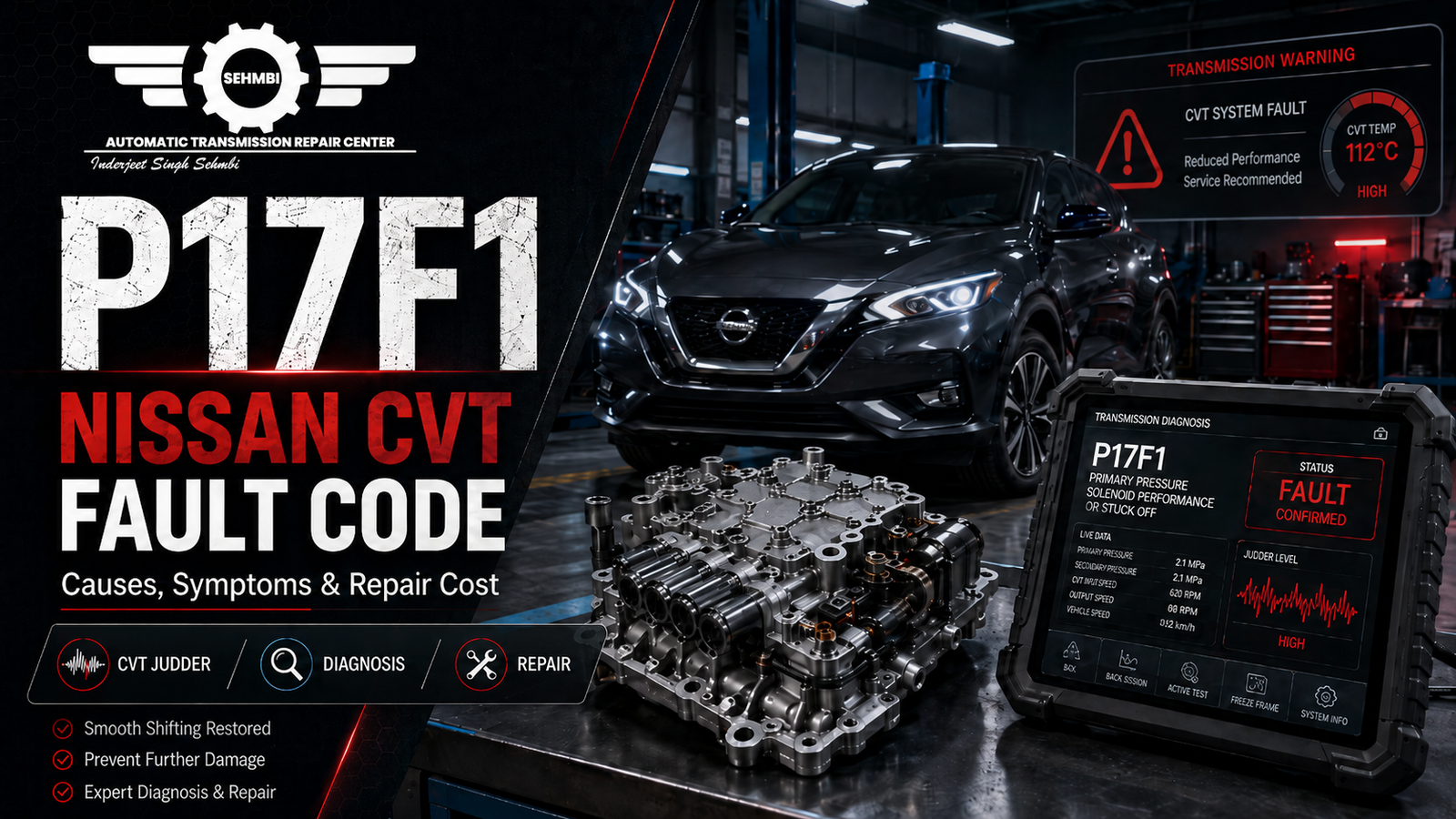
The P17F1 Nissan CVT fault code is a manufacturer-specific transmission code associated with CVT judder. Nissan technical service bulletins describe P17F1 as a CVT judder-related code that requires further inspection, especially when the driver reports shaking, shuddering, vibration, hesitation or multiple bumps during acceleration.
If your Nissan is showing CVT jerking, shuddering, slipping, delayed acceleration, overheating, a transmission warning light or limp mode, the fault should be diagnosed before approving a valve-body or complete CVT replacement.
P17F1 Quick Answer: P17F1 means the Nissan CVT control system has detected a judder-related condition. Depending on the specific Nissan model and diagnostic findings, the problem may involve the control valve/valve body, hydraulic pressure, CVT fluid, or internal CVT components. Nissan service procedures require further inspection rather than assuming that one specific part has failed.
What Does P17F1 Mean on a Nissan CVT?
The Nissan P17F1 fault code is linked with abnormal judder detected by the CVT control system.
Nissan describes CVT judder complaints as conditions such as:
- Shaking
- Shuddering
- Single or multiple bumps
- Vibration
These symptoms may occur while accelerating or during normal driving. Nissan has also introduced enhanced diagnostic logic for P17F0 and P17F1 so that the transmission control module can identify CVT judder conditions more accurately.
A CVT differs from a conventional automatic transmission because it changes ratios continuously rather than relying on a traditional set of fixed gears. If you want to understand how these systems differ, read our CVT vs DSG vs Torque Converter comparison.
Common P17F1 Nissan CVT Symptoms
The P17F1 fault code symptoms vary depending on the condition of the transmission and whether other DTCs are stored.
Common warning signs include:
- Nissan CVT judder symptoms
- Nissan CVT shudder during acceleration
- Nissan CVT vibration problem
- Nissan CVT jerking
- Delayed acceleration
- Nissan CVT slipping
- Engine RPM increasing without expected road speed
- Hesitation under acceleration
- Poor power delivery
- CVT overheating
- Transmission warning light
- Nissan CVT limp mode
- Repeated P17F1 after code clearing
Nissan bulletins specifically associate P17F1 diagnosis with customer reports of shake, shudder, bumps or vibration. Some applicable Nissan procedures also reference hesitation or lack of power as symptoms that may accompany CVT-related faults.
If the vehicle is already jerking or losing drive, read the signs your automatic gearbox needs immediate repair before continuing to drive.
P17F1 Symptoms and Possible Diagnostic Areas
| Symptom |
Possible area to investigate |
| Judder while accelerating |
CVT control / internal CVT |
| Shudder or vibration |
Belt/chain, pulley or hydraulic control |
| Delayed acceleration |
Valve body / pressure control |
| CVT slipping |
Hydraulic or internal wear |
| Warning light + P17F1 |
CVT diagnostic inspection |
| Limp mode |
TCM protection / transmission fault |
The table is intended for diagnostic guidance. P17F1 alone should not be used as a parts-replacement instruction.
What Causes P17F1 Nissan CVT Fault Code?
1. CVT judder and internal transmission wear
The primary condition associated with P17F1 CVT fault code is CVT judder.
Depending on the Nissan transmission and inspection findings, internal wear may contribute to:
- Shuddering
- Slipping
- Vibration
- Hesitation
- Abnormal ratio operation
Some Nissan P17F1 repair procedures specifically instruct technicians to remove the control valve and perform an internal CVT chain inspection before deciding the repair path.
This is why possible Nissan CVT belt problem or Nissan CVT pulley damage should be evaluated rather than assumed.
2. Nissan CVT valve-body problem
A Nissan CVT valve body problem can also be relevant to P17F1 diagnosis.
The valve body controls transmission hydraulic operation through fluid passages and electronically operated control components. Depending on the vehicle and bulletin, Nissan may direct technicians toward control-valve replacement when P17F0 or P17F1 are the applicable stored codes. A 2024 Nissan bulletin, for example, states that on certain covered applications where P17F0 and/or P17F1 are the only stored DTCs, a new control valve is installed.
That does not mean every P17F1 requires a valve body. Model-specific diagnosis remains necessary.
3. CVT hydraulic-pressure problems
Hydraulic pressure plays an important role in CVT operation.
Problems with pressure control may cause:
- Delayed response
- Jerking
- Slipping
- Judder
- Poor acceleration
- Fail-safe operation
P17F1 may also appear with pressure-related codes such as P0776 or P0841 on some Nissan applications, so a complete scan is important when diagnosing a P17F1 Nissan transmission fault.
4. Nissan CVT fluid problem
Correct CVT fluid is critical for lubrication, cooling and hydraulic operation.
Poor fluid condition, incorrect fluid or fluid-level problems can affect transmission behaviour, although fluid replacement alone cannot repair internal wear.
Nissan repair bulletins for applicable CVTs specify Nissan NS-3 CVT Fluid or, in some customer-pay procedures, an approved equivalent depending on the specific bulletin and application.
For transmission-fluid maintenance information, read How Often Should You Change Automatic Transmission Oil?.
P17F1 vs P17F0 Nissan CVT Fault Codes
P17F0 and P17F1 are both associated with Nissan CVT judder, but Nissan service procedures can direct technicians through different inspection paths.
| Fault Code |
Main Diagnostic Focus |
| P17F1 |
CVT judder requiring specified inspection path |
| P17F0 |
CVT judder requiring transmission-related inspection |
The exact Nissan terminology and repair procedure varies by bulletin and vehicle application, so technicians should follow the correct factory procedure for the VIN and CVT model.
Is P17F1 a Valve Body Fault or Internal CVT Failure?
It can involve either area.
A professional P17F1 transmission judder inspection should follow a logical diagnostic process:
- Confirm P17F1 with Nissan-compatible diagnostic equipment.
- Check whether P17F0 or other CVT codes are also stored.
- Confirm whether the customer actually experiences judder.
- Inspect CVT fluid condition and level.
- Review live-data and pressure behaviour.
- Evaluate the control valve/valve body.
- Inspect internal CVT components if the applicable procedure requires it.
- Decide whether valve-body repair, rebuilding or replacement is justified.
Nissan bulletins make an important distinction: some judder-related procedures only apply when P17F0/P17F1 and an actual customer judder complaint meet the stated conditions.
Important
Do not replace the complete CVT based on P17F1 alone. The correct repair depends on the Nissan model, additional DTCs, symptoms and internal inspection results.
Can P17F1 Cause Nissan CVT Limp Mode?
Yes. A serious Nissan CVT transmission problem can cause the transmission control system to limit normal operation to protect the gearbox.
Possible symptoms include:
- Reduced acceleration
- Limited ratio operation
- High RPM with poor response
- Transmission warning messages
- Restricted power
- Fail-safe or limp mode
If this is happening repeatedly, read Why Is My Car Stuck in Limp Mode? Causes & Fixes.
How Is P17F1 Diagnosed?
A proper P17F1 CVT repair starts with diagnosis rather than guessing.
Testing may include:
- Nissan-compatible computerized scanning
- Freeze-frame analysis
- Customer judder verification
- Road test
- CVT fluid inspection
- Hydraulic-pressure assessment
- Valve-body/control-valve evaluation
- TCM data analysis
- Internal chain/belt and pulley inspection where required
- Related DTC analysis
This diagnostic approach is consistent with Nissan technical procedures that direct qualified technicians through specific inspections before selecting the repair.
P17F1 Nissan CVT Repair Options
The correct repair depends on the confirmed failure.
CVT fluid service: Appropriate when servicing is due and no major internal damage is found.
Valve-body/control-valve repair or replacement: May be required where hydraulic-control problems are confirmed.
Internal CVT repair or rebuilding: May be appropriate when chain/belt, pulley, bearing or other internal damage is identified.
Complete CVT replacement: May be recommended when damage is severe or rebuilding is not economically practical.
A qualified Nissan CVT specialist should determine the repair path only after inspection.
P17F1 Nissan CVT Repair Cost in Mumbai
The P17F1 Nissan repair cost cannot be accurately calculated from the code alone.
The final P17F1 Nissan CVT transmission repair cost depends on whether the vehicle needs:
- Diagnostic testing
- CVT fluid service
- Sensor or solenoid work
- Valve-body repair
- Control-valve replacement
- Internal CVT rebuilding
- Belt/chain and pulley repair
- Complete CVT replacement
SEHMBI’s current Automatic Transmission Repair Cost in Mumbai – 2026 Price Guide states that automatic transmission work can range broadly from approximately ₹5,000 for minor servicing or sensor-related repairs to ₹3,00,000 or more for major rebuilding or replacement; an individual P17F1 repair quotation requires vehicle-specific diagnosis.
P17F1 Nissan CVT Repair in Mumbai
If you need Nissan P17F1 fault code repair in Mumbai, avoid approving a complete CVT replacement before the transmission has been properly tested.
SEHMBI Automatic Transmission Repair Center offers diagnosis and repairs for CVT and other automatic gearbox systems in Mumbai. Its site recommends fluid inspection, computerized scanning and internal assessment before major CVT replacement decisions.
For broader assistance, visit the best automatic transmission repair centre in Mumbai.
Nissan showing P17F1, CVT judder or shudder?
Book a computerized CVT inspection before approving valve-body or complete transmission replacement.
Call SEHMBI: +91 98337 71779
Frequently Asked Questions
What does P17F1 mean on Nissan CVT?
P17F1 is a Nissan CVT judder-related code used when further CVT inspection is required after abnormal shake, shudder, bumps or vibration are detected or reported.
What causes P17F1 CVT fault code?
Possible diagnostic areas include CVT hydraulic control, control valve/valve body, fluid condition and internal CVT components. The exact cause must be confirmed by inspection.
Can P17F1 cause CVT limp mode?
Yes. Significant CVT problems may lead to restricted or fail-safe operation to protect the transmission.
Can I drive with P17F1?
If the Nissan is severely juddering, slipping, overheating, losing acceleration or entering limp mode, avoid prolonged driving and arrange CVT diagnosis.
Does P17F1 mean complete CVT replacement?
No. Depending on the specific Nissan model and inspection results, repair may involve the control valve, hydraulic system or internal CVT, while severe damage may require replacement.
Can P17F1 be repaired without replacing the CVT?
Yes, in some cases. Nissan procedures for certain applications include control-valve replacement rather than complete transmission replacement, but other cases may reveal internal damage requiring more extensive repair.
Should CVT fluid be changed when repairing P17F1?
That depends on the vehicle and repair procedure. Applicable Nissan bulletins specify Nissan NS-3 CVT fluid for certain P17F1-related repairs.